
Crystal Formation Speed
To compare how different cooling rates affect crystal size and formation in salt solutions
Theory & Background
Crystal formation depends on the rate of cooling and concentration of solutions. Slow cooling allows larger, more organized crystals to form, while rapid cooling creates smaller crystals. This principle explains the formation of different rock types in geology.
Required Materials
- Table salt
- Hot water
- 3 identical containers
- Magnifying glass
- Ice bath
- Insulated container
- String
- Measuring spoons
Estimated Time
Setup: 20 minutes, Observation: 3-5 days
Step-By-Step Procedure
Create saturated salt solutions by dissolving salt in hot water until no more dissolves.
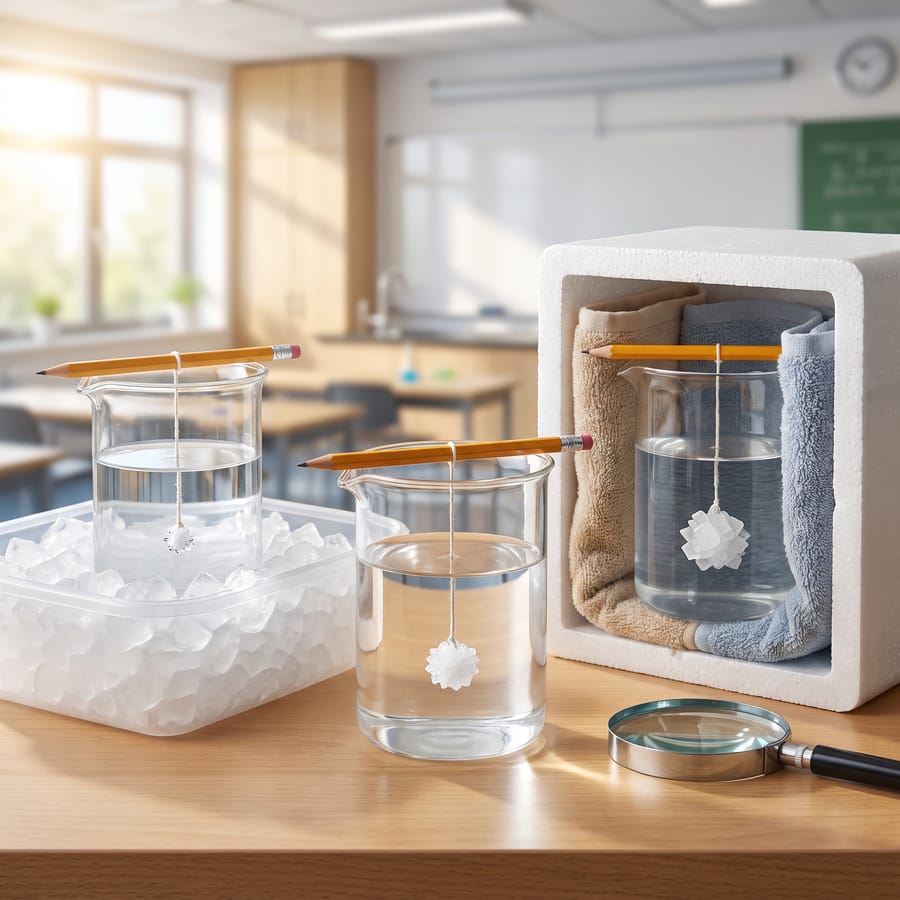
Pour equal amounts into three containers and suspend strings in each solution.
Place one container in an ice bath for rapid cooling.
Leave one container at room temperature for moderate cooling.
Wrap the third container in towels and place in an insulated box for slow cooling.
Observe crystal formation daily and record sizes and shapes.
After 3-5 days, examine crystals with a magnifying glass and compare.
⚠️ Experiment Tips
- Use hot water to create truly saturated solutions.
- Keep containers undisturbed during crystal formation for best results.
- Document with photos to show size differences clearly.
- Try this with different salts like Epsom salt for comparison.
Observation
The rapidly cooled solution produces many small crystals. Room temperature cooling creates medium-sized crystals. Slow cooling produces fewer but larger, more well-formed crystals.
Result & Conclusion
Cooling rate significantly affects crystal formation. This principle explains why igneous rocks have different crystal sizes - volcanic rocks (fast cooling) have small crystals while plutonic rocks (slow cooling) have large crystals.