
Enzyme Reaction Speed
To observe how temperature affects the speed of enzyme reactions using catalase from potatoes
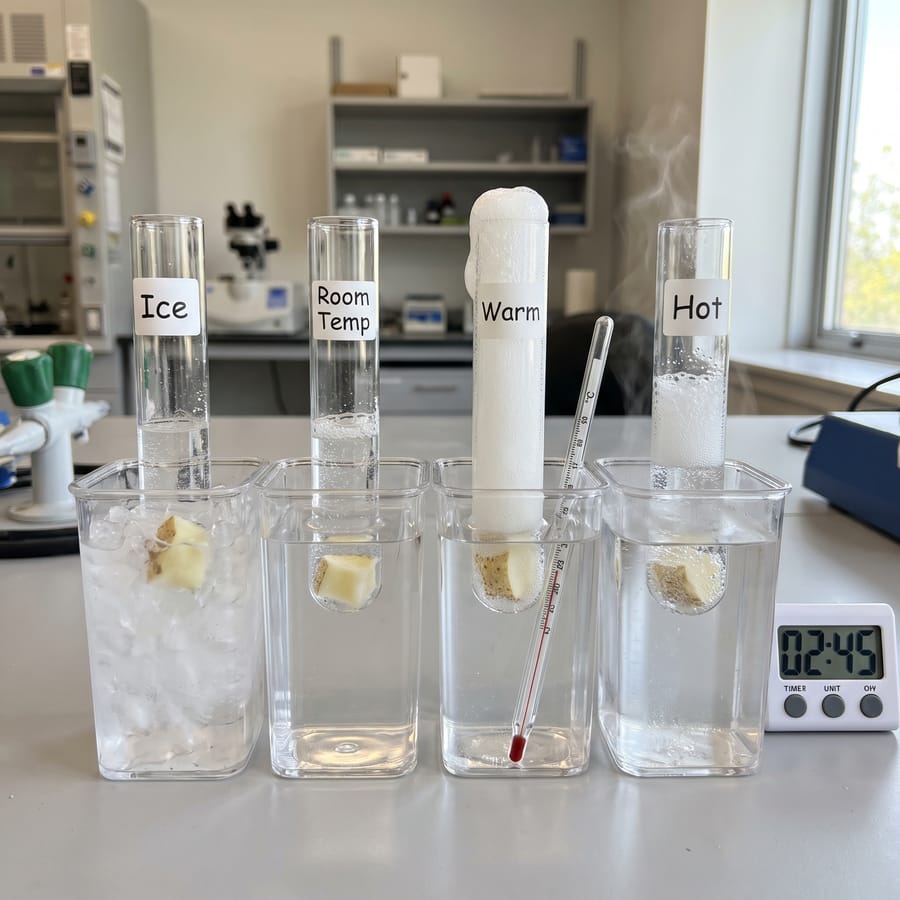
Theory & Background
Enzymes are biological catalysts that speed up chemical reactions. Their activity is highly dependent on temperature - too cold and they work slowly, too hot and they denature. Catalase breaks down hydrogen peroxide into water and oxygen, creating visible bubbles.
Required Materials
- Fresh potatoes
- 3% hydrogen peroxide
- 4 test tubes
- Hot water bath
- Ice bath
- Thermometer
- Knife
- Timer
- Measuring spoons
Estimated Time
30-45 minutes
Step-By-Step Procedure
Cut potato into small, uniform pieces and place equal amounts in 4 test tubes.
Prepare water baths at different temperatures: ice bath (0°C), room temperature (20°C), warm (40°C), and hot (70°C).
Place one test tube in each water bath and wait 5 minutes for temperature equilibration.
Quickly add 2ml of hydrogen peroxide to each tube and immediately start timing.
Observe and record the rate of bubble formation in each tube for 5 minutes.
Count or estimate bubbles produced per minute at each temperature.
Graph your results showing temperature vs. reaction rate.
⚠️ Experiment Tips
- Use fresh potatoes for best enzyme activity.
- Keep hydrogen peroxide in a cool, dark place before use.
- Work quickly when adding hydrogen peroxide to get consistent timing.
- Consider plotting your results on a graph to visualize the temperature-activity relationship.
Observation
At ice temperature, few bubbles form. Room temperature produces moderate bubbling. The warm bath shows vigorous bubbling. The hot bath initially bubbles then slows or stops as the enzyme denatures.
Result & Conclusion
Enzyme activity increases with temperature up to an optimal point, then decreases rapidly as the enzyme denatures. This demonstrates the temperature sensitivity of biological catalysts and explains why organisms maintain specific body temperatures.