
Golden Ratio in Nature
To discover and measure the golden ratio (phi) in natural objects and understand mathematical patterns in nature
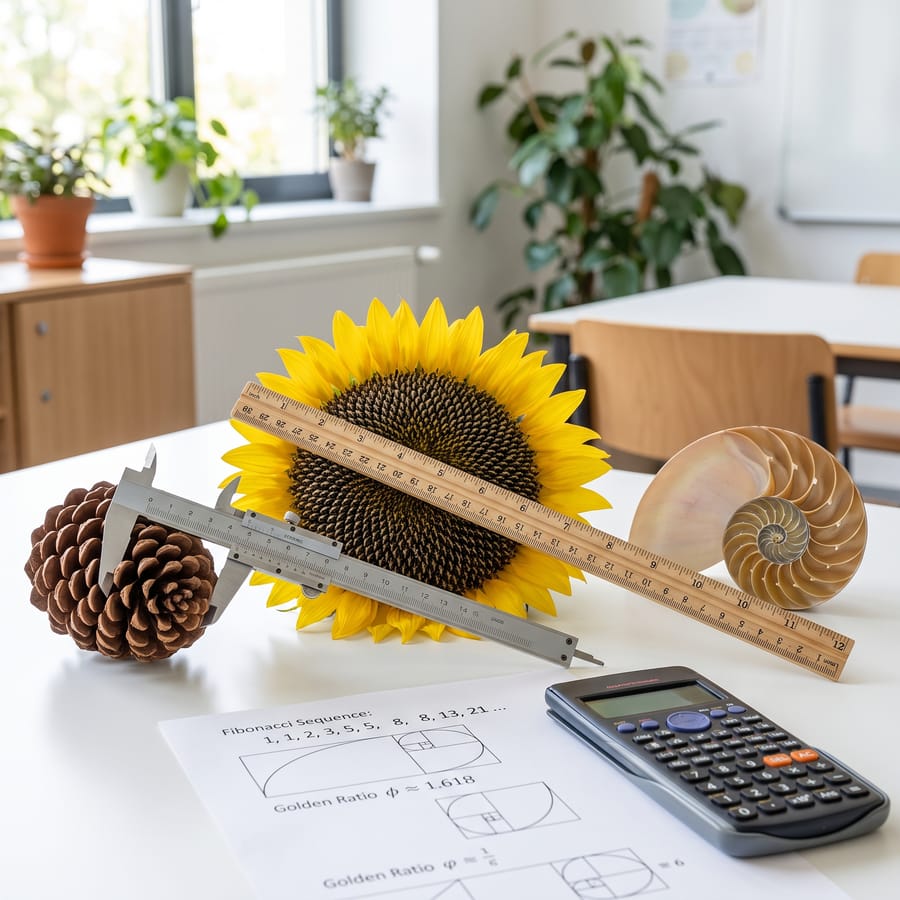
Theory & Background
The golden ratio (φ ≈ 1.618) appears frequently in nature, from flower petals to shell spirals. This mathematical constant creates pleasing proportions and efficient growth patterns that have fascinated mathematicians and scientists for centuries.
Required Materials
- Pinecones
- Flowers (sunflowers, daisies)
- Shells
- Rulers
- Calculators
- Calipers or measuring tools
- Camera
- Worksheets for recording
Estimated Time
1-2 hours
Step-By-Step Procedure
Collect various natural objects: pinecones, flowers, shells, tree branches.
Measure spiral patterns in pinecones by counting spirals in each direction.
Measure sunflower seed spiral patterns and record the numbers.
Measure shell spiral dimensions and calculate ratios between successive measurements.
Look for Fibonacci sequences in flower petals and leaf arrangements.
Calculate ratios and compare to the golden ratio (1.618).
Document findings with photos and measurements.
⚠️ Experiment Tips
- Use precise measuring tools for more accurate ratios.
- Look for Fibonacci numbers: 1,1,2,3,5,8,13,21,34,55,89...
- Calculate successive ratios to see how they approach phi.
- Consider why these patterns might be advantageous in nature.
Observation
Pinecones often show Fibonacci spirals (8:13, 13:21). Sunflowers typically display 34:55 or 55:89 spiral ratios. Shell measurements approach the golden ratio in their proportions.
Result & Conclusion
Many natural objects contain mathematical relationships approaching the golden ratio. This demonstrates how mathematics underlies natural growth patterns and structural efficiency in living organisms.