
Lung Capacity Test
To measure and compare lung capacity between different individuals and understand factors affecting respiratory function
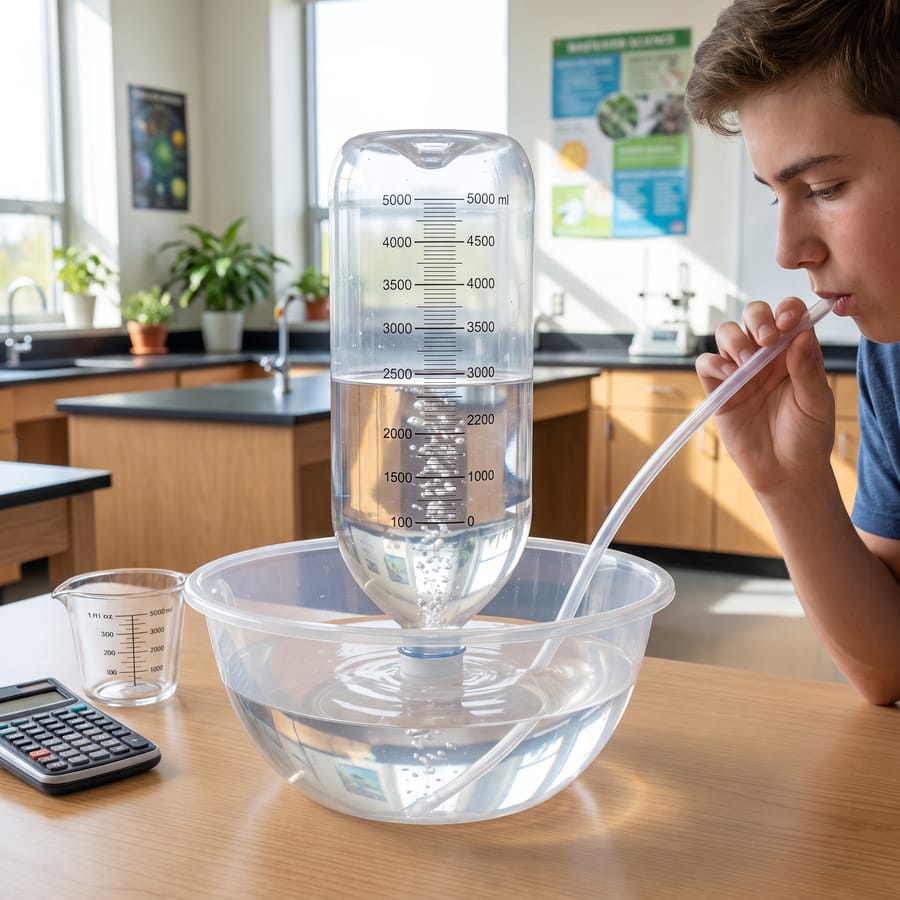
Theory & Background
Lung capacity refers to the volume of air that can be held in the lungs during different phases of breathing. Factors like age, fitness level, height, and health conditions can affect lung capacity. Understanding these measurements helps assess respiratory health.
Required Materials
- Large plastic bottle (2-3 liters)
- Flexible tubing
- Large bowl or container
- Water
- Measuring cup
- Ruler
- Permanent marker
- Calculator
Estimated Time
45 minutes to 1 hour
Step-By-Step Procedure
Fill the large bottle completely with water and mark measurement lines every 100ml.
Fill a large bowl with water and invert the filled bottle into it, keeping the mouth underwater.
Insert one end of the tubing into the bottle opening while keeping it underwater.
Have test subjects take the deepest breath possible and exhale slowly through the tube.
Measure the amount of water displaced from the bottle - this represents lung capacity.
Record results for multiple subjects and compare measurements.
Calculate averages and look for patterns based on age, height, and fitness level.
⚠️ Experiment Tips
- Ensure the tube stays underwater throughout each test to get accurate measurements.
- Have subjects practice proper breathing technique before recording measurements.
- Clean and sanitize equipment between different test subjects.
- Consider testing the same person at different times to check consistency.
Observation
Different individuals show varying lung capacities. Generally, taller and more physically fit individuals tend to have larger lung capacities. Age can also be a factor, with capacity typically peaking in young adulthood.
Result & Conclusion
The experiment demonstrates individual variation in lung capacity and helps identify factors that influence respiratory function. This technique provides a simple way to measure and compare lung volumes.