
Taste Bud Mapping
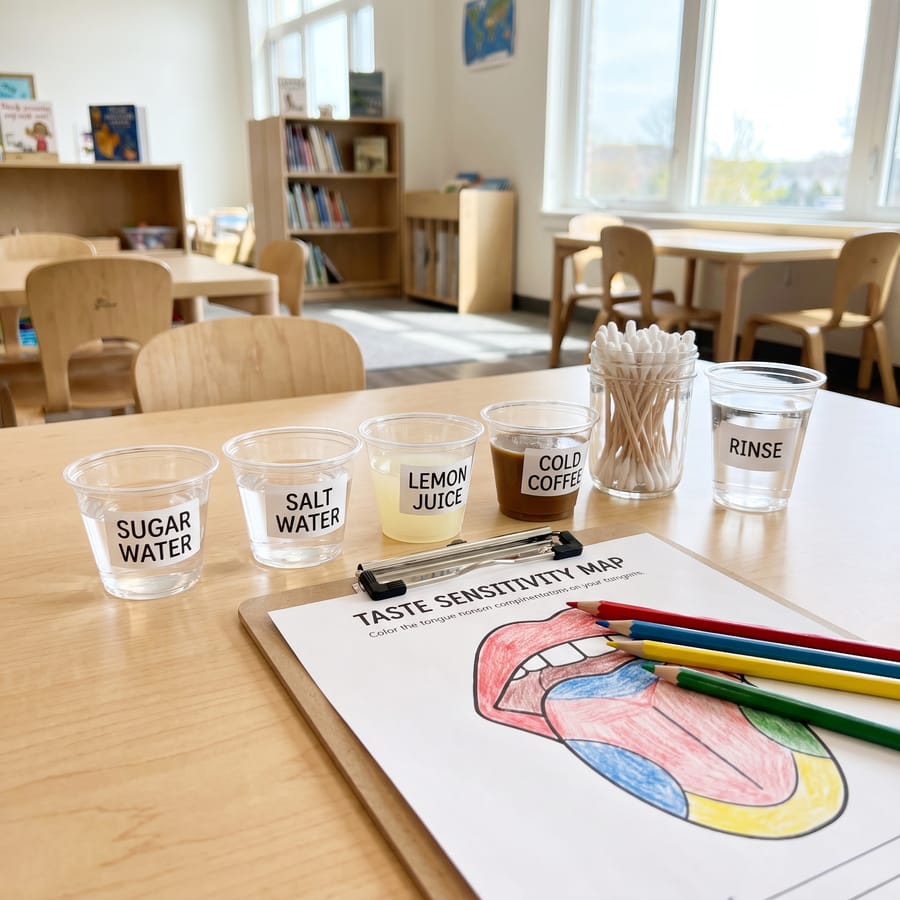
To map different taste sensitivities across the tongue and understand how taste perception works
Theory & Background
Taste buds detect five basic tastes: sweet, sour, salty, bitter, and umami. While all areas of the tongue can detect all tastes, some regions may be more sensitive to certain flavors. Modern research shows the tongue map is more complex than once thought.
Required Materials
- Sugar water
- Salt water
- Lemon juice
- Coffee (bitter)
- Cotton swabs
- Small cups
- Tongue diagram worksheets
- Colored pencils
- Water for rinsing
Estimated Time
30-45 minutes
Step-By-Step Procedure
Prepare taste solutions: sugar water (sweet), salt water (salty), diluted lemon juice (sour), cold coffee (bitter).
Create a tongue diagram worksheet for recording results.
Use cotton swabs to apply small amounts of each solution to different tongue areas.
Test tip, sides, back, and center of tongue with each taste.
Rinse mouth with water between each test.
Record intensity of taste sensation (1-5 scale) for each location.
Color-code results on tongue diagram and compare with classmates.
⚠️ Experiment Tips
- Use very dilute solutions to avoid overwhelming taste buds.
- Always rinse between tests to prevent taste interference.
- Test with clean cotton swabs for each solution.
- Consider how smell affects taste perception during testing.
Observation
Different areas of the tongue show varying sensitivity to different tastes. Sweet sensitivity may be stronger at the tip, while bitter sensitivity is often stronger at the back. Individual variations exist between people.
Result & Conclusion
Taste perception involves complex interactions between taste buds, smell, and brain processing. While general patterns exist, individual differences in taste sensitivity demonstrate biological diversity in sensory perception.