
Theory & Background
Have you ever noticed how light behaves in different situations? What exactly is the color white, and is it truly a color? It's a question that's been asked many times before. In this experiment we'll explore what the color what is and how to create it using a few sheets of cellophane and three flashlights. White is a representation of additive color mixing. The overlapping projection of the primary color lights of red, green, and blue (RGB) combine to form the color white at the appropriate intensities. In other words, to form the color white, we need to combine red, green and blue lights in an overlapping pattern and at the correct offset.
Required Materials
- 3 flashlights of the same size and light intensity
- Red cellophane
- Green cellophane
- Blue cellophane
- Tape
Estimated Time
About 10 minutes
Step-By-Step Procedure
Attach the red cellophane over the top of the first flashlight using your tape.
Attach the blue cellophane over the top of the second flashlight using your tape.
Attach the green cellophane over the top of the third flashlight using your tape.
Turn on the flashlights
Place the flashlights on a table, about 4 inches apart and shine them onto a white wall.
This part may take some patience. Arrange the flashlights so that the light from each flashlight overlaps with the other flashlights. The easiest way to achieve this is to place the center flashlight on a shoebox, so it's slightly higher than the flashlights to the left and right of it.
When you finally have the colors overlapping, look closely at the wall. What do you see?
Experiment Tips
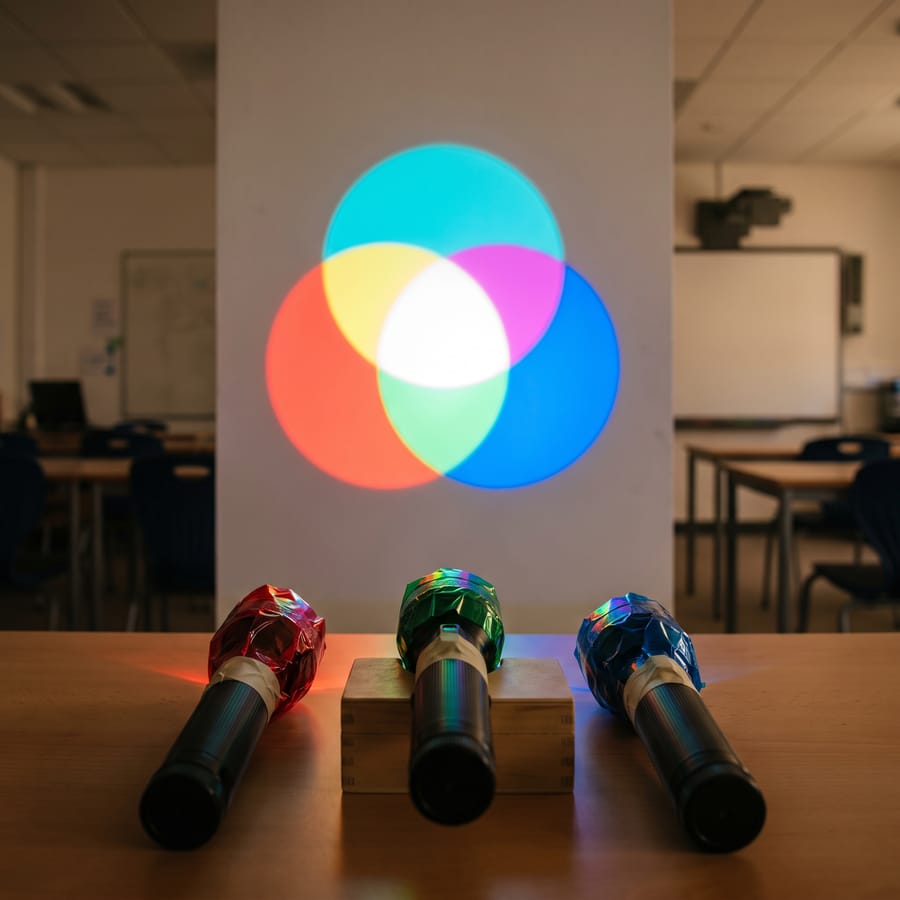
- The image in figure A will help you to visualize the resulting pattern that should appear on your wall when you have the flashlights lined up correctly. Use it to help guide you in placing the flashlights in the appropriate pattern. Figures & Illustrations Figure A
Observation
Take a close look at the pattern on the wall. Can you spot anything interesting? Take a look at the overlapping colors from the corners of each light. What can you derive from the patterns?
Result & Conclusion
When the experiment is set-up correctly, you will see a white center and three surrounding circles of varying colors. The full intensity of all three colors gives a white color. The pinkish color produced when the blue overlaps with the red is called magenta. The color produced when the green overlaps with the blue is called cyan. The color produced when the red overlaps with the green is called Yellow. Magenta, cyan and yellow (CYMK, where K is key black) are known as subtractive colors.