

Theory & Background
Bernoulli’s (pronounced Burr New Lee) principle is named after Daniel Bernoulli (1700-1782), an eighteenth-century Swiss scientist and mathematician who discovered this phenomenon. This principle states that when a gas or liquid is in motion, its pressure gets reduced; and the faster the motion, the higher is the reduction in pressure.
Bernoulli’s Principle is what allows wings of aircrafts to produce lift and enables planes and helicopters to fly. The aircraft wings are made in such a manner that air flowing across their upper surface is at a faster rate as compared to the air that rushes past its lower surfaces and due to Bernoulli’s principle this lowers the pressure above the wings. The pressure below the wings is higher in comparison, producing the lifting force that keeps the airplane flying. Factors that affect the amount of lift created are density of air and the speed at which an aircraft is flying and most important of all, the shape of the wing.
Required Materials
- Drawing pin
- Cardboard piece
- Cotton reel
Estimated Time
Less than 5 minutes
Step-By-Step Procedure
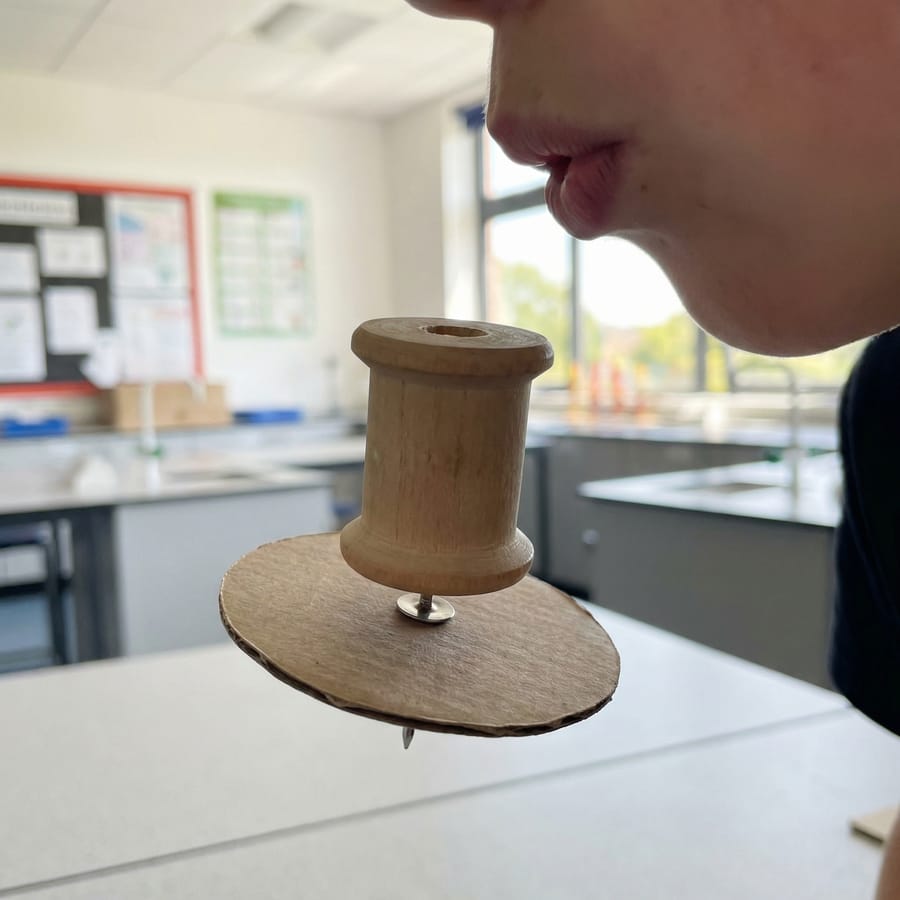
Insert a drawing pin through the centre of a cardboard piece
Place a cotton reel over the point of the pin
Hold the cotton reel in one hand and the card in the other
Blow air down through the hollow of the cotton reel as hard as you can
Simultaneously release the card
Experiment Tips
- Ensure that the cardboard piece is symmetrically shaped for best results.
Observation
The cardboard does not fall but remains stuck to the cotton reels as long as you blow air through the reel.
Result & Conclusion
Blowing into the cotton reel causes air to flow rapidly over the top of the card, reducing the air pressure. The stronger air pressure under the card keeps it from giving in to gravity. Bernoulli’s principle is thus demonstrated.