

CO2 & Photosynthesis
To demonstrate that carbon dioxide is necessary for plant leaves to carry out photosynthesis
Theory & Background
Plants use sunlight and carbon dioxide present in air to produce food for itself; in the absence of either photosynthesis is affected adversely. Food produced is in the form of starch, the presence of which can be tested chemically using Iodine solution – it turns starch black.
Required Materials
- 2 Potted plants2 Bell
- jarsA CandleDish containing Caustic soda Petroleum jellyGlass sheetsIodine solution to test leaves for starch
Estimated Time
Approximately 10 minutes to set up the apparatus and 8-12 hours to carry out the observations
Step-By-Step Procedure
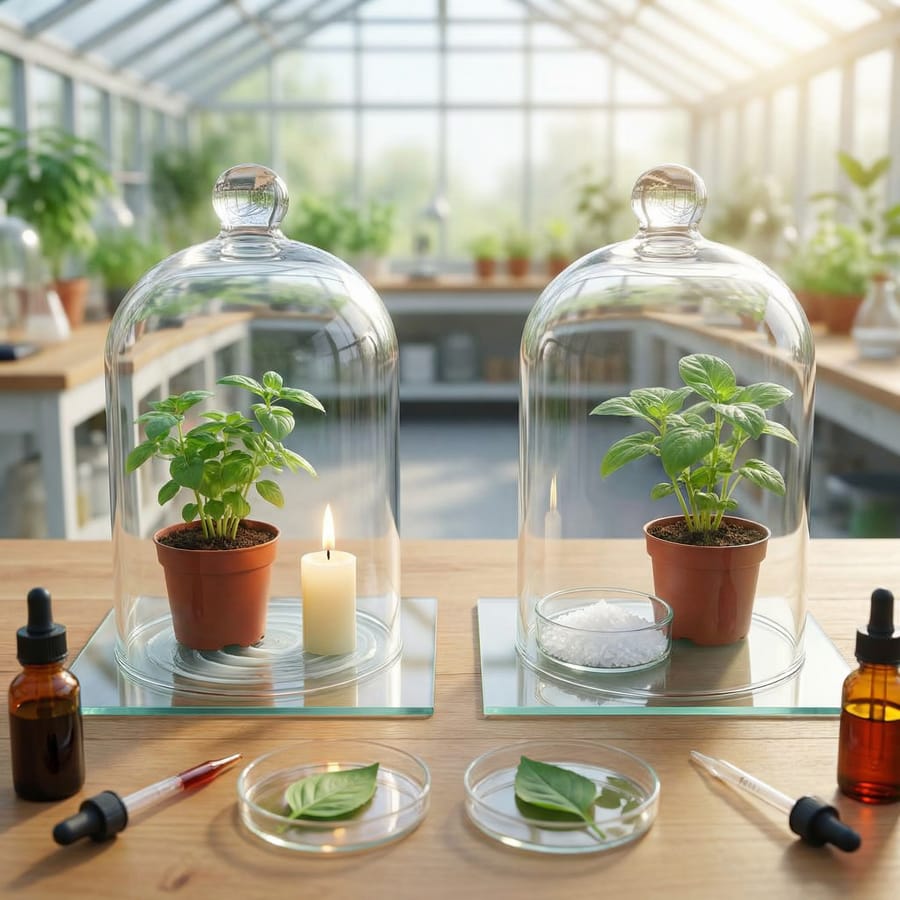
Take two young potted plants.
Apply petroleum jelly on two glass sheets.
Place the potted plants on these glass sheets.
On one glass sheet, along with the potted plant place a burning candle.
In the other, place a dish containing caustic soda.
Cover them with the bell jars.
Leave undisturbed for a few hours and test the leaves from each pot for the presence of starch.
Experiment Tips
- Potted plants must ideally have been kept in the dark to make the leaves starch-free before including them in this experiment.The petroleum jelly makes the bell jars airtight.
Observation
On testing leaves from each plant for the presence of starch it is observed that the leaves of the plant that had the lighted candle with it shows the presence of starch, while the other plant had no starch.
Result & Conclusion
The lighted candle used up the oxygen in the sir within the jar by combustion and replaced it with carbon dioxide. This was used by the plant to photosynthesize. The other plant was deprived of carbon dioxide since the dish of caustic soda absorbed all the carbon dioxide in the air under this bell-jar. It was therefore unable to produce starch. Hence carbon dioxide is necessary for photosynthesis.