

Theory & Background
Pascal’s Law states that when you apply pressure to confined fluids (contained in a flexible yet leak-proof enclosure so that it can’t flow out), the fluids will then transmit that same pressure in all directions within the container, at the same rate.
The simplest instance of this is stepping on a balloon; the balloon bulges out on all sides under the foot and not just on one side. This is precisely what Pascal’s Law is all about – the air which is the fluid in this case, was confined by the balloon, and you applied pressure with your foot causing it to get displaced uniformly.
Pascal’s Principle and Hydraulics
Hydraulic systems use an incompressible fluid, such as oil or water, to transmit the force applied within the fluid from one location to another. Most aircrafts use hydraulics in the braking systems as well as landing gear.
Pneumatic systems use compressible fluids such as air for their operation. Some aircrafts also utilize pneumatic systems for their brakes, landing gear as well as the movement of wing flaps.
Required Materials
- Matchsticks
- Bottle
- Rubber balloon
- Twine
Estimated Time
Less than 5 minutes
Step-By-Step Procedure
Prepare the matchsticks by cutting off the heads of the matches and discarding the tail ends (portions without the combustible head).
Fill the bottle to the brim with water
Drop the matchstick-heads into the bottle
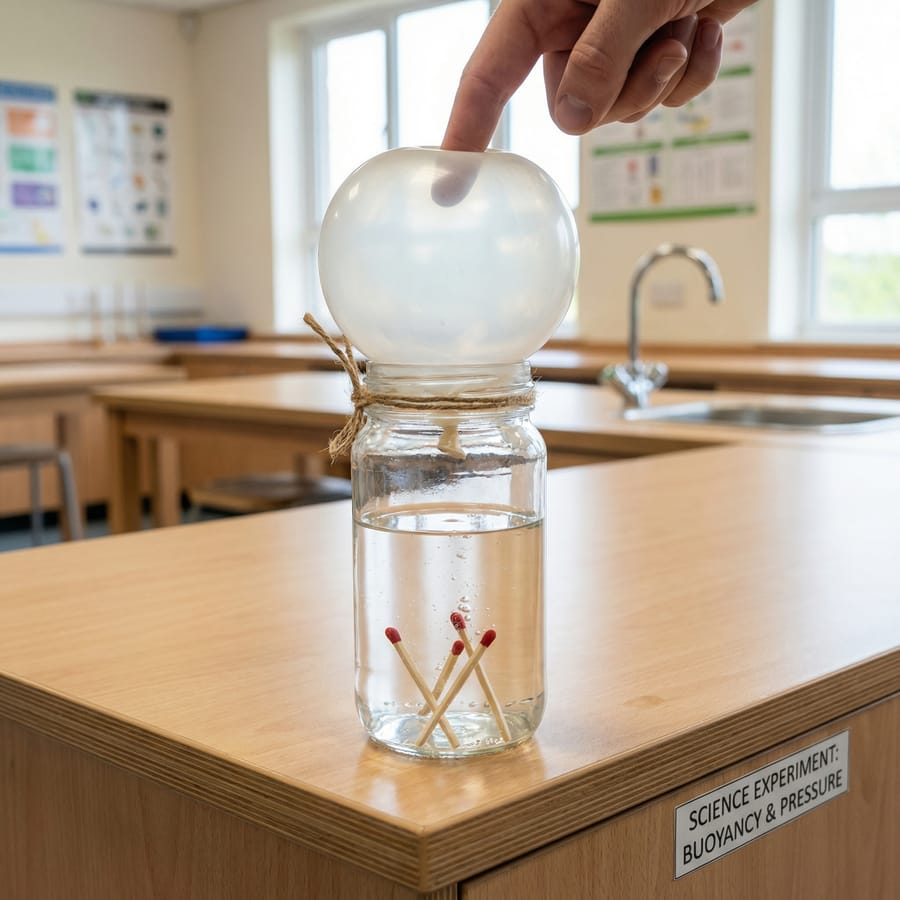
Cover the mouth of the balloon tightly over the bottle’s opening.
Press your finger on the balloon ‘diaphragm’ covering the mouth of the bottle.
Experiment Tips
- Ensure that the balloon you choose will fit tightly around the mouth of the bottle you choose for the experiment. You may use twine to secure the balloon to the mouth of the bottle if necessary.
Observation
The match heads will float on top of the water initially but as soon as the finger is pressed on the balloon diaphragm, they will begin to sink slowly to the bottom. However, when the finger is lifted, the matchstick-heads float up again.
Result & Conclusion
The match heads move down owing to the pressure that is transmitted through the water. When the finger is pressed down on the balloon diaphragm, a small quantity of water penetrates into each match head, which adds enough weight it causing it sink. When the finger is removed, there is ample air pressure inside the match heads to force out the water and make the match heads rise again. Pascal’s Law is proven hence.