

Plant Sleep Cycles
To observe and study circadian rhythms in plants by tracking leaf movement and growth patterns over a 24-hour period
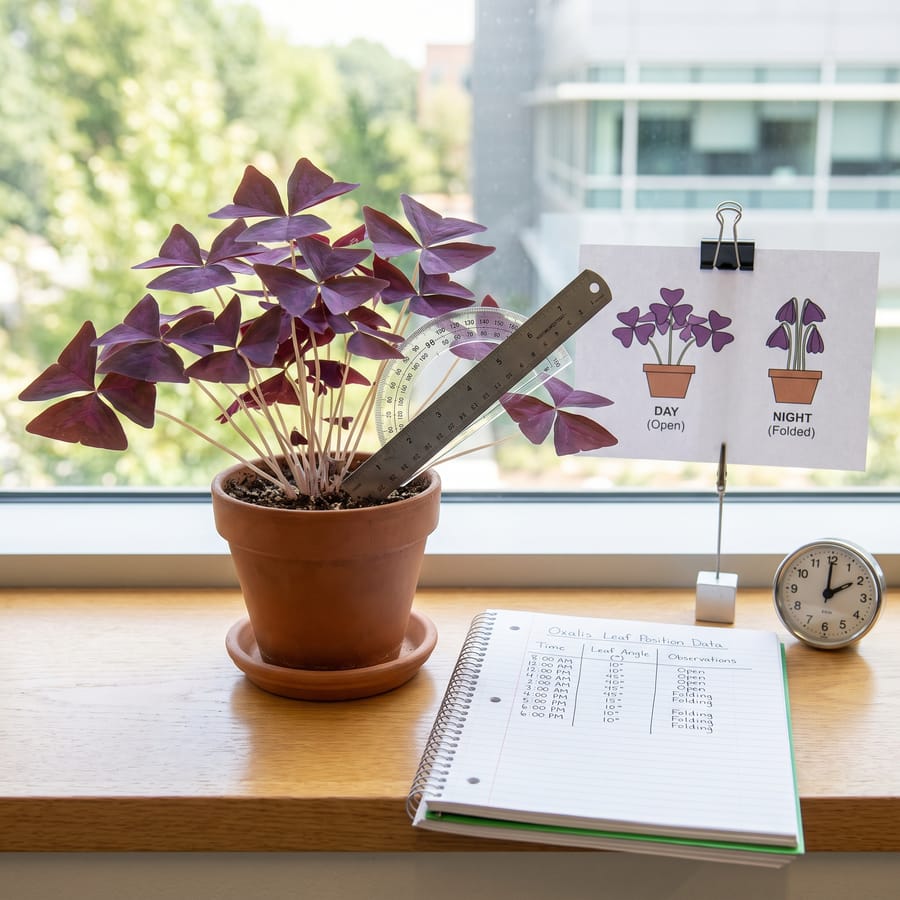
Theory & Background
Plants have internal biological clocks called circadian rhythms that control many daily activities. These rhythms cause leaves to move, flowers to open and close, and growth rates to change throughout a 24-hour cycle. Many plants exhibit sleep-like behaviors called nyctinasty, where leaves fold or close at night and reopen during the day. This conserves water and protects the plant from temperature fluctuations. Studying these patterns helps us understand how plants respond to light and dark cycles.
Required Materials
- Bean plant or oxalis (wood sorrel)
- Ruler or measuring tape
- Camera or smartphone
- Notebook and pen
- Flashlight or lamp
- Timer or alarm clock
Estimated Time
24-48 hours of observation over 2-3 days
Step-By-Step Procedure
Choose a healthy plant with visible leaves, such as a bean plant, oxalis, or prayer plant.
Set up your observation station where you can access the plant every 2-3 hours.
Starting at 6 AM, take a photo of the plant and measure the angle of 3-5 leaves from the stem.
Record observations every 2 hours throughout the day, including at 10 PM and 2 AM.
Note any changes in leaf position, overall plant posture, and any opening/closing of flowers.
Repeat the process for 2-3 days to confirm patterns and create a time-lapse record.
Experiment Tips
- Use consistent lighting conditions for photos to better see leaf position changes.
- Set alarms to remind yourself to check the plant, especially during nighttime observations.
- Keep the plant in its normal location - don't move it to different lighting conditions.
- Consider creating a time-lapse video if you have the equipment available.
Observation
During the day, leaves are typically spread wide and oriented toward light sources. As evening approaches, many plants begin to fold or droop their leaves. At night, leaves may close completely or fold downward. In early morning, leaves gradually reopen and return to their daytime positions.
Result & Conclusion
Plants exhibit circadian rhythms similar to animal sleep cycles. These daily movements help plants conserve water, protect delicate tissues, and optimize photosynthesis. The consistent timing of these movements demonstrates that plants have internal biological clocks that regulate their daily activities.