

Build a Seismograph
To build a working model of a seismograph and record the shaking of a pretend earthquake.
Theory & Background
How do scientists measure something as fast and violent as an earthquake? They use a seismograph, and the secret behind it is inertia — a heavy object at rest tends to stay at rest even when everything around it moves.
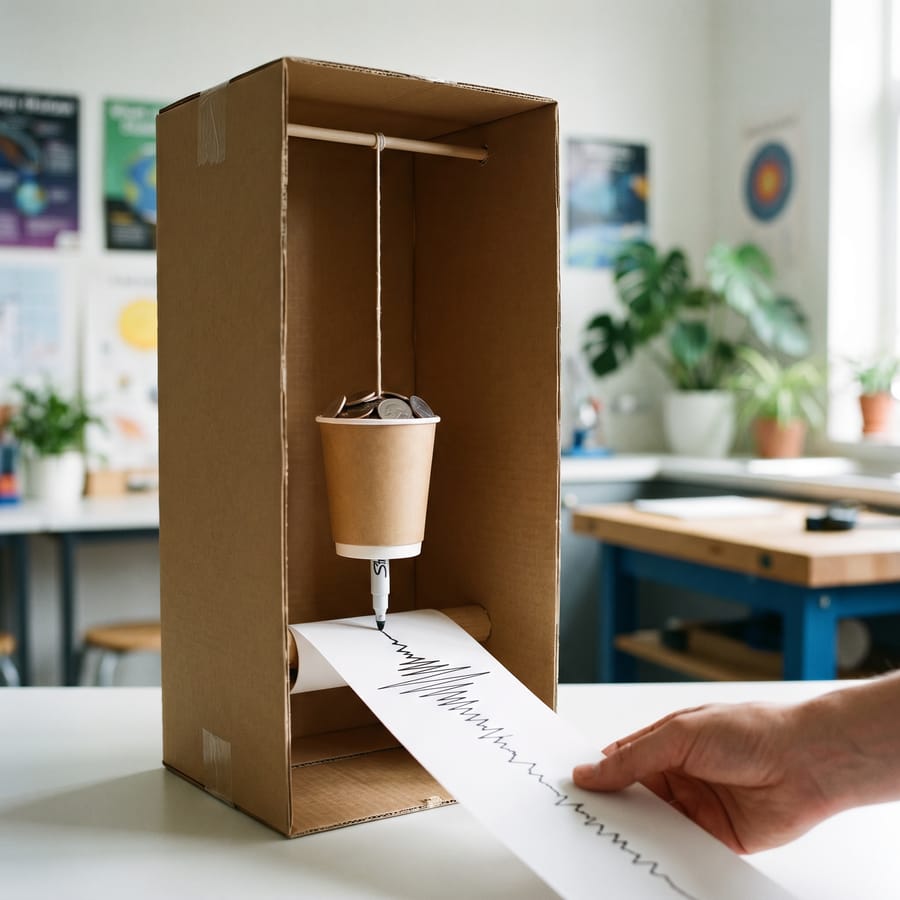
In a seismograph, the ground and the machine shake, but a suspended weight holding a pen stays almost perfectly still, so the pen traces the ground’s movement onto a moving strip of paper. The wiggly line it draws is called a seismogram, and the taller the wiggles, the stronger the quake.
Required Materials
- A sturdy cardboard box (like a shoebox stood on end)
- A paper or plastic cup
- String
- A marker or felt-tip pen
- A few coins or small stones (to weight the cup)
- Tape and scissors
- A long strip of paper
- A helper
Estimated Time
About 45 minutes to 1 hour
Step-By-Step Procedure
Stand the cardboard box on its end so an open side faces you, like a little stage.
Poke two holes near the top edges of the box and thread a string across so it hangs like a clothesline.
Make two small holes near the rim of the cup on opposite sides, and hang the cup from the string so it dangles inside the box, close to the bottom.
Drop a few coins into the cup to make it heavy. Push the marker through a hole in the bottom of the cup so the tip points straight down and just touches the floor of the box.
Cut a long strip of paper, slide it under the marker tip, and take the cap off the marker.
Have your helper slowly and steadily pull the paper strip straight through, under the pen, while the box stays still — the pen should draw a straight line.
Now gently shake the box from side to side (your “earthquake”) while your helper keeps pulling the paper. Try gentle shakes, then stronger ones.
Experiment Tips
- The heavier you make the cup, the better it stays still and the cleaner your recording will be.
- Keep the paper moving at a steady speed so the timing of your “earthquake” is easy to read, and compare the lines from gentle versus strong shakes.
Observation
When the box is still, the pen draws a straight line. When you shake the box, the pen traces jagged back-and-forth zig-zags — taller, wilder zig-zags when you shake harder.
Result & Conclusion
The weighted cup stayed still because of inertia while the box and paper moved with your “earthquake,” so the pen recorded the shaking as a seismogram. Real seismographs work the very same way, and the height of the wiggles tells scientists how strong a quake was — that’s how earthquake magnitudes are measured.