

Tsunami in a Tank
To model how an undersea earthquake creates a tsunami and to see why tsunami waves grow so tall near the shore.
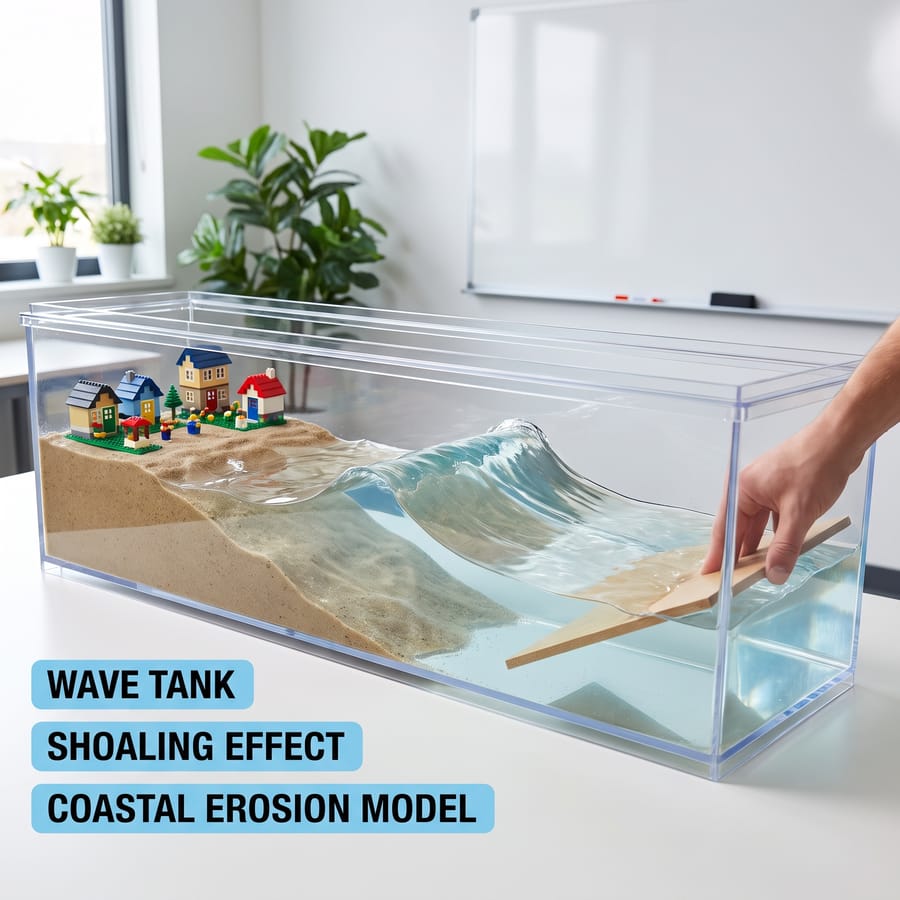
Theory & Background
A tsunami is nothing like an ordinary wind-driven wave. It is usually caused by an undersea earthquake that suddenly lifts or drops the ocean floor. That sudden shove sets a huge amount of water moving as a fast, low wave across the deep ocean.
As the wave reaches the shallow water near a coast, it slows down and its energy piles up, so the wave grows dramatically taller and surges far inland. In this experiment you’ll build a mini-ocean and make your own tsunami.
Required Materials
- A long, clear plastic container or storage tub
- Water
- A board or books to make a sloping “beach” at one end
- A flat piece of stiff plastic or a small board that fits inside the tub (the “sea floor”)
- A few small light toys or Lego blocks (a “coastal village”)
- A towel for spills
Estimated Time
About 30 to 45 minutes
Step-By-Step Procedure
Build a gently sloping “beach” at one end of the container using a tilted board (or a slope of sand) so part of the tub is shallow like a coastline.
Fill the container with water so the far end is several inches deep and the water thins out to nothing over the beach.
Place your small “village” toys on the dry part of the beach, just above the waterline.
At the deep end, hold the flat board vertically and lower it near the bottom — this is the sea floor.
Make an “undersea earthquake”: sharply and suddenly push the board upward and forward through the water, then hold it still.
Watch the wave travel from the deep end toward the beach, and notice how it changes as it reaches the shallow water.
Record how far up the beach the water rushes and what happens to your village. Try a gentle “quake” and a strong one.
Experiment Tips
- A sharp, sudden lift of the board makes a much better tsunami than a slow push — it’s the suddenness that matters, just like a real quake.
- Do this near a sink or outside, because it will splash. Measure how far up the beach the water reaches for weak versus strong “earthquakes” to turn it into a real experiment.
Observation
The sudden lift sends a single low, wide wave gliding across the deep water. As it reaches the shallow beach, the wave slows, steepens, grows taller, and surges far up the slope — sweeping over your little village.
Result & Conclusion
Just like a real tsunami, the sudden displacement of water (not wind) created the wave, and the shallow water forced its energy upward into a tall, powerful surge. This models why coastal towns can be flooded far inland, and why tsunami warning systems keep a constant watch for undersea earthquakes.