

Graham Cracker Tectonics
To model the three ways Earth’s tectonic plates move against each other — using graham crackers and frosting.
Theory & Background
Earth’s hard outer shell is cracked into giant puzzle pieces called tectonic plates that slowly drift on the hot, soft rock beneath them. Almost all earthquakes happen along the boundaries where these plates meet.
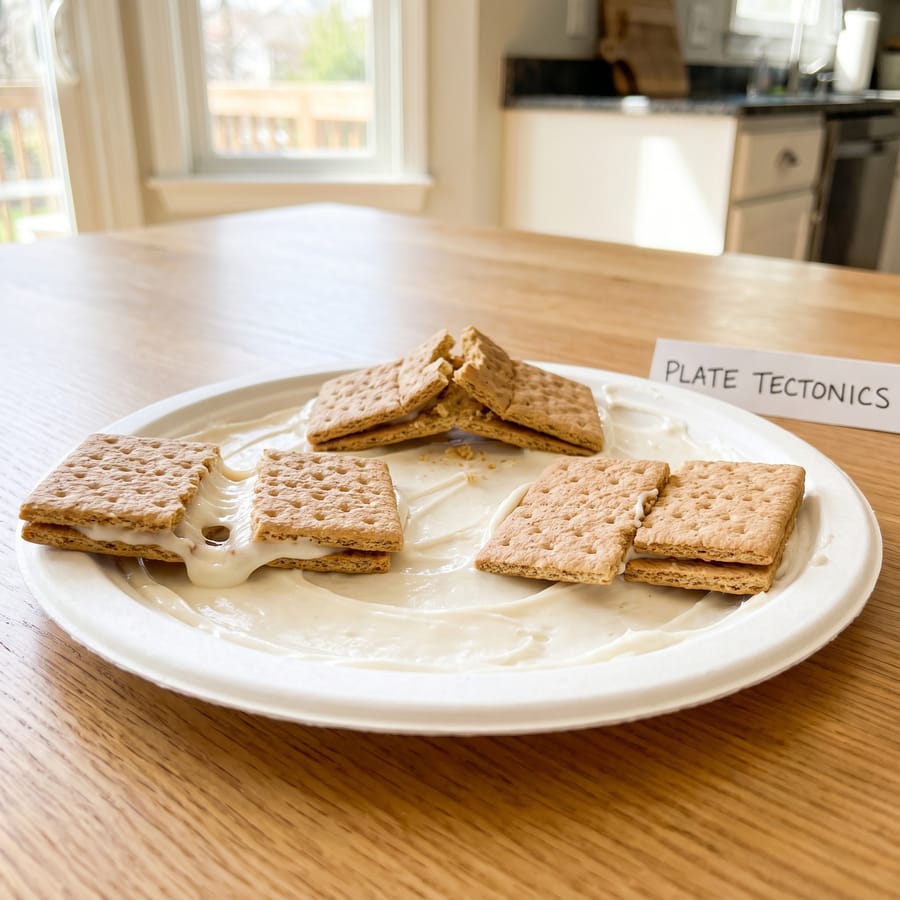
Plates can crash together (a convergent boundary), pull apart (a divergent boundary), or grind past each other sideways (a transform boundary). In this tasty model, graham crackers are the plates and frosting is the gooey mantle they slide on.
Required Materials
- Graham crackers
- A tub of frosting (or creamy peanut butter)
- A paper plate
- A small cup of water
- A butter knife
- An appetite
Estimated Time
About 30 minutes
Step-By-Step Procedure
Spread a thick layer of frosting (about ½ cm) across the paper plate — this is the soft, hot mantle the plates ride on.
Convergent (colliding) boundary: dip one end of two graham crackers in water for a few seconds to soften them, lay them on the frosting, and slowly push them together. Watch the softened edges crumple and buckle upward.
Divergent (spreading) boundary: place two dry crackers next to each other on the frosting and slowly pull them apart. Watch the frosting well up into the gap between them.
Transform (sliding) boundary: place two crackers side by side and slide them past each other in opposite directions. Notice how they grind, catch, and then suddenly jerk.
Record what happens at each boundary and which real Earth feature it creates.
Experiment Tips
- Soften only the very edges of the crackers for the convergent test — too much water and they’ll fall apart.
- Push and pull slowly, the way real plates move (only a few centimeters a year!). When you’re done experimenting, you can eat your tectonic plates.
Observation
Colliding crackers crumple and push up into ridges, like mountains. Spreading crackers leave a gap where frosting oozes up, like new crust. Sliding crackers catch, resist, and then suddenly slip with a jolt.
Result & Conclusion
You’ve modeled real plate boundaries. Convergent boundaries build mountains and cause powerful earthquakes; divergent boundaries create brand-new ocean floor as magma rises; and transform boundaries — like California’s San Andreas Fault — store up stress until the plates suddenly slip. That sudden “jerk” of your sliding crackers is exactly how a fault earthquake happens.