

Earthquake-Resistant Tower
To discover which building designs best survive an earthquake by shake-testing model towers on a homemade shake table.
Theory & Background
Have you ever wondered how skyscrapers stay standing during an earthquake? Earthquakes release energy as seismic waves that make the ground shake side to side and up and down. Buildings get into trouble when this shaking matches their natural rhythm of swaying — they wobble harder and harder until they collapse.
Engineers fight back with three tricks: a wide base for stability, triangular cross-bracing to stiffen the frame, and flexible “base isolators” that let the ground move without dragging the building along. In this experiment you’ll build model towers and shake-test them to find the toughest design.
Required Materials
- Mini marshmallows or gum drops
- A box of toothpicks (or uncooked spaghetti)
- A shallow baking tray or cookie sheet
- A ruler
- A small square of foam (optional “base isolator”)
- A stopwatch or phone timer
- Notebook and pencil
Estimated Time
About 1 to 2 hours
Step-By-Step Procedure
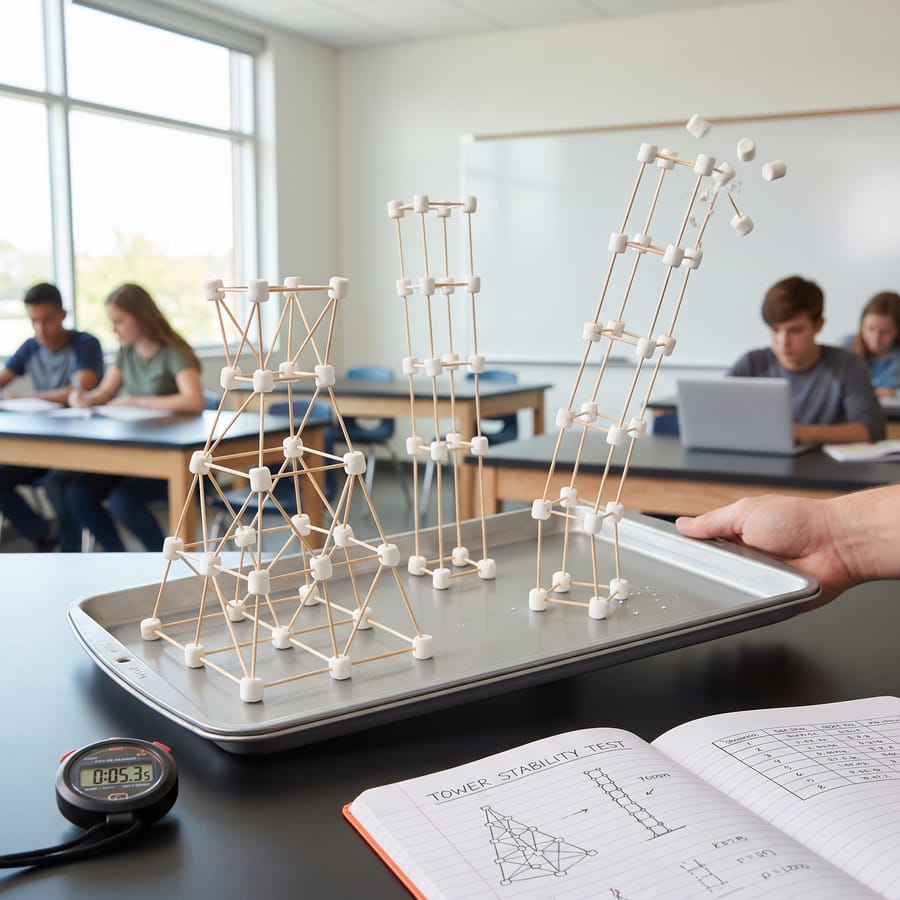
Build three towers out of marshmallows and toothpicks, all the same height (about 8 inches / 20 cm). Make Tower A a simple stacked-square tower, Tower B with triangle cross-braces on each side, and Tower C with a wide base that narrows toward the top.
Press the bottom of each tower firmly onto the baking tray so the base marshmallows stick in place.
Set the tray on a smooth, flat table. This is your “shake table.”
Grip the tray and shake it side to side at a slow, steady rhythm — about two shakes per second. Keep each shake the same strength.
Slowly speed up the shaking and watch the towers. Use your stopwatch to time how long each tower stays standing (or count the shakes until it falls).
Record which design lasted longest and how each one failed.
Rebuild the towers and test again to make sure your results are consistent.
Experiment Tips
- Keep every tower the same height and use the exact same shaking motion — the design is the only thing you should change (that’s your variable).
- For a more realistic shake table, rest the tray on two round pencils so it can slide, and tug it back and forth. Try setting one tower on a square of squishy foam as a “base isolator” and see if it survives longer.
Observation
The tall, narrow, un-braced tower wobbles the most and topples first. The towers with triangular cross-bracing and a wide base sway far less and stay standing much longer.
Result & Conclusion
Triangles and wide bases spread the shaking forces so the tower can’t sway out of control, and a foam base soaks up the motion before it reaches the tower. This is exactly why real earthquake-resistant buildings use steel cross-braces, broad foundations, and rubber base isolators — they let the ground move without letting the building shake itself apart.