

Soil Liquefaction
To find out why buildings sink and tip over during earthquakes by turning solid, wet sand into a liquid.
Theory & Background
During a strong earthquake, ground that is sandy and full of water can suddenly act like a liquid — a startling process called liquefaction. The shaking jostles the sand grains until they lose contact with one another and float in the water, so the soil can no longer hold up whatever is sitting on it.
The result is dramatic: heavy buildings sink and tilt, while light, hollow things buried underground can actually float up to the surface. It shows that what the ground is made of matters just as much as how strong the earthquake is.
Required Materials
- A clear plastic container or large cup
- Clean sand (enough to fill it about ¾ full)
- Water
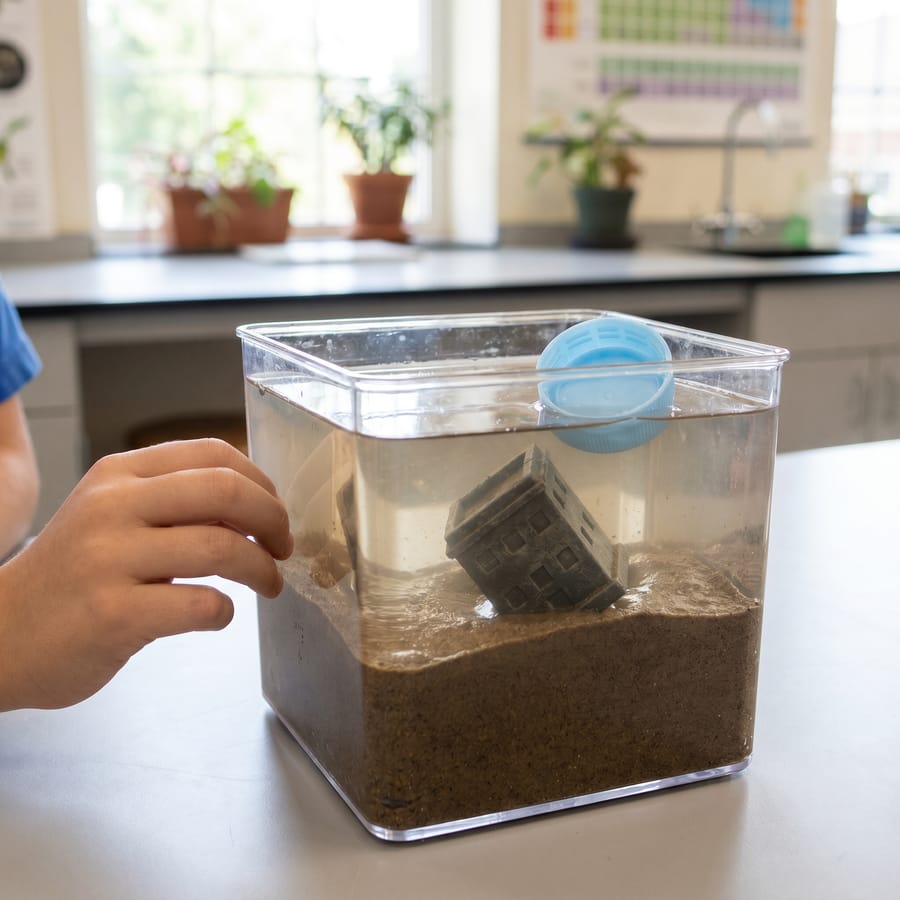
- A small heavy “building” (a metal bolt, a coin-weighted toy, or a small car)
- A light hollow object (an empty film canister or bottle cap)
- A sturdy table you can gently thump
Estimated Time
About 30 minutes
Step-By-Step Procedure
Fill the clear container about three-quarters full with sand.
Slowly pour in water until it just reaches the top of the sand. The sand should look damp and firm, not soupy.
Gently set your heavy “building” on top of the sand. It should sit still — the ground feels solid.
Bury the light hollow object a few centimeters down in the sand on the other side of the container.
Now make an “earthquake”: rapidly tap or thump the side of the container (or the table) for several seconds.
Watch the surface of the sand and both objects closely while you keep shaking.
Stop, let everything settle, and record what happened to each object.
Experiment Tips
- Use clean, fine sand for the most dramatic effect — it liquefies far more easily than coarse gravel.
- Run the test twice — once with barely-damp sand and once with fully water-soaked sand — to see how the amount of water changes the result.
Observation
As you shake, water rises to the surface and the sand turns soupy. The heavy “building” tips over and sinks down into the sand, while the buried hollow object wiggles upward and pops toward the surface.
Result & Conclusion
The shaking forced water up between the sand grains until they could no longer support any weight — the ground briefly became a liquid. Dense objects sink and buried light objects float, exactly like real buildings sinking and underground pipes rising during earthquakes in wet, sandy areas. This is why engineers test the soil before building in earthquake zones.