

Cloud Cover
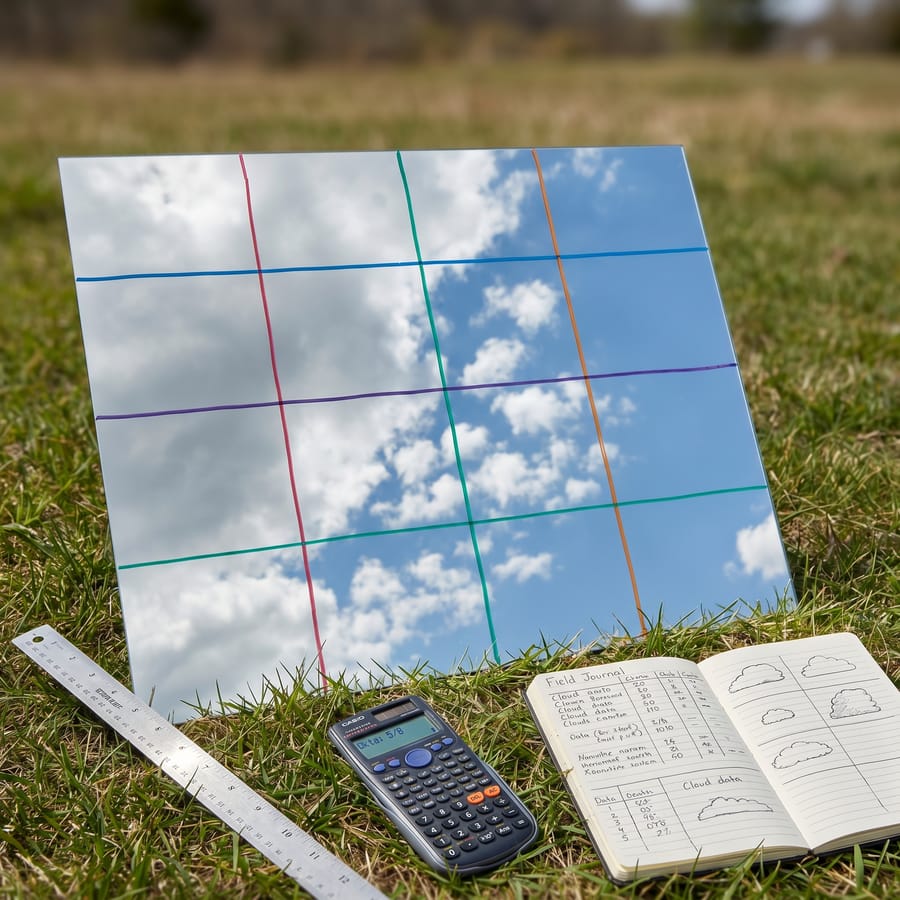
To measure the amount of cloud cover using just a few simple tools found around the house.
Theory & Background
Have you ever wondered about this fascinating scientific process? Meteorologists measure the amount of cloud cover in the sky using a unit of measurement called an “okta.” Basically, one okta is one eighth of the sky that is covered in cloud. The severity of cloud cover ranges from zero oktas to eight, with zero being a completely clear sky and eight oktas being complete cloud cover.
Required Materials
- Large mirror
- Ruler
- Crayon or permanent marker
- Area of your yard where you can place the mirror and it will reflect only sky
- Journal or logbook
- Calculator (if required)
Estimated Time
An hour to a month, depending on how many days you would like to record the cloud cover.
Step-By-Step Procedure
Use the ruler and the crayon or marker to divide your mirror into sixteen equal parts. They do not have to be any certain shape or size, just as long as each 1/16 of the mirror is the same size as another.
Determine the amount of time you wish to measure cloud cover. Do you want to measure the cloud cover for only one day or each day for one week? Do you want to measure the cloud cover for an entire month?
Take the mirror that has been divided into sixteen equal parts outside, to the area of your yard where there will be no trees or other objects that reflect off of the mirror.
Count the number of sections on the mirror that are reflecting clouds. If two of the sixteen mirrored sections are covered with clouds and is 2/16. This is, however, a fraction that can be reduced to 1/8, therefore your okta measurement is 1. If ten of the sixteen sections are covered in clouds, you can convert 10/16 to 5/8 and your okta rating would be 5.
Repeat these steps for each day that you would like to measure cloud cover.
Experiment Tips
- If you measure the cloud cover for a period of time, make sure to compile a graft of your data.
Observation
It can be fun to observe how the cloud cover will differ from day to day and even from hour to hour. What do you think is responsible for these changes?
Result & Conclusion
At the end of your experiment, you will have enough data to allow you to make a general assumption of cloud cover without actually having to measure the oktas. You’ll be surprised at how good you get at guessing how much cloud cover there really is!