
Dissolving in Liquids
To explore the extent to which different solids will dissolve in water at a given temperature and compare the results.
Theory & Background
Have you ever wondered about the amazing properties of water? A solvent can be defined as a substance that has the inherent capacity to dissolve a wide range of ‘solutes’ including bases and acids. Water is one such substance and it is not incidental that water has earned itself the distinction of being known as the ‘universal solvent’. A saturated solution is one where the amount of solute is more than what the solvent (here, water) can dissolve. The simplest way to ascertain whether a solution is saturated is when a portion of the solute continues to remain without being dissolved, at the container holding the solution.
Required Materials
- Distilled water
- Beakers
- Powdered glass
- Slaked lime
- Common salt
- Evaporating basins
- Sand bath
- Tripod stand
- Wire gauze
- Bunsen burner
Estimated Time
Approximately 15 minutes to set up the apparatus; dissolving and evaporation time may vary depending on the quantity of water taken.
Step-By-Step Procedure
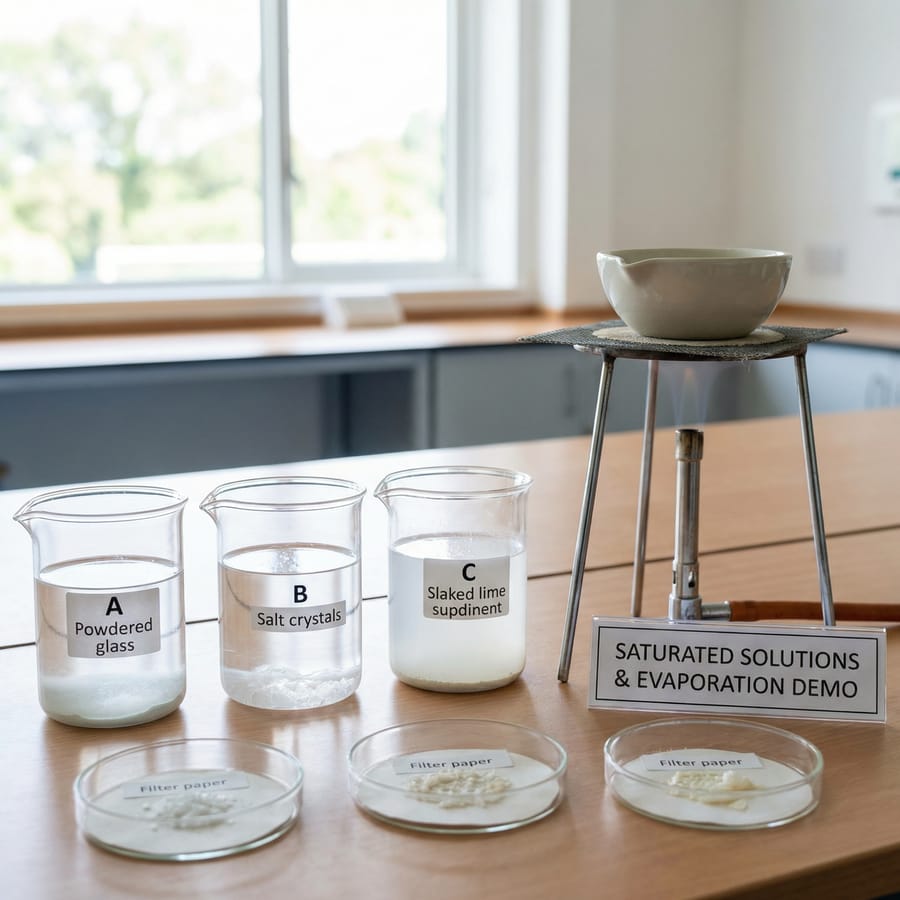
Pour equal volumes of distilled water in three separate beakers.
To the first beaker add powdered glass, to the second add common salt and to the third add slaked lime.
Continue to add each solute until the solution is saturated.
Filter each solution into an evaporating basin.
Evaporate completely over a sand bath to dryness.
Compare the residues.
Experiment Tips
- Adult supervision may be necessary while handling powdered glass. This may be replaced with sand for safety purposes.
Observation
The solution of powdered glass leaves barely any residue. The solution of slaked lime leaves traces or ‘rings’ of lime on the sides of the evaporating dish. The solution of salt leaves a substantial quantity of solid residue.
Result & Conclusion
The amount of residue obtained after evaporation is the best indicator of the degree of solubility of solutes. It is therefore safe to conclude that different substances (solutes) dissolve in different amounts in the same solvent under the same pressure / temperature conditions. The experiment hence shows that glass least soluble in water, while slaked lime dissolves to a small extent and salt dissolves to a much greater extent in this universal solvent.