

Distillation of Water
To convert impure water into chemically pure water by distillation
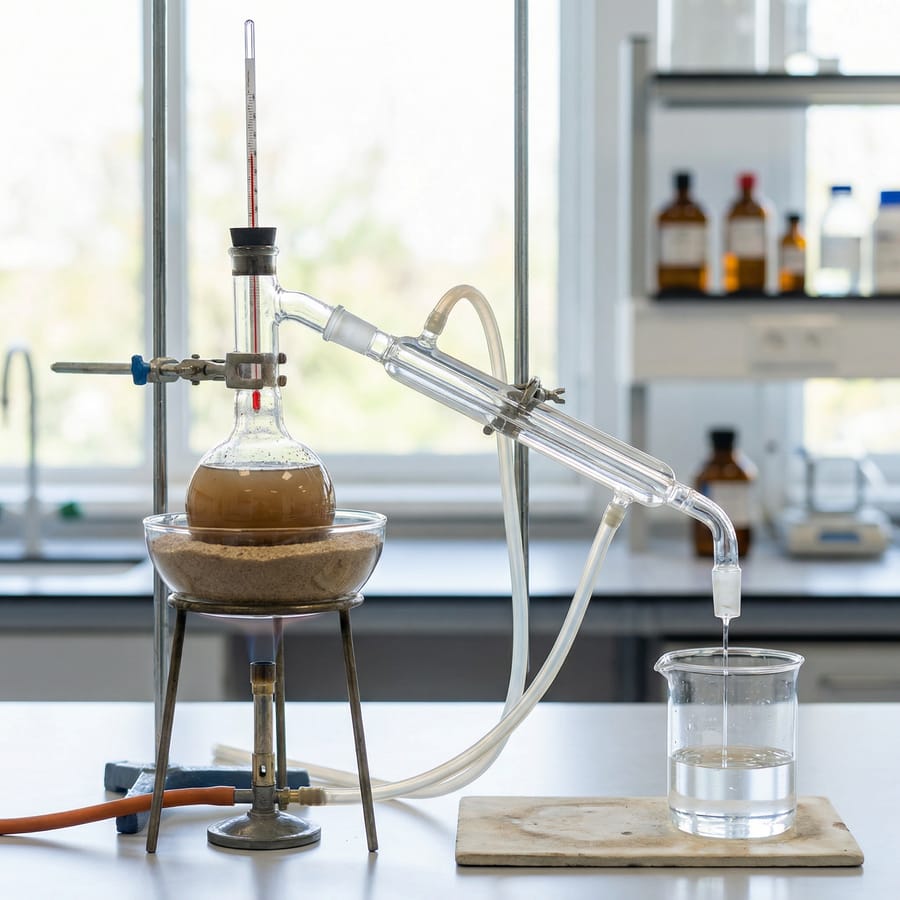
Theory & Background
Have you ever wondered about the amazing properties of water? Distilled water finds its use in a wide range of applications where the natural dissolved salts that water normally contains are not desirable. Some of these are topping up lead acid batteries, preparing aseptic solutions in hospitals, automotive cooling systems, steam irons, etc. Distilled water is not however, considered to be suitable for human consumption on a regular basis simply because it lacks the natural beneficial minerals that ordinary drinking water contains. Besides, its bland taste is not very pleasant to the taste buds!
Required Materials
- Impure (muddy) water
- Distilling flask with thermometer
- Liebig’s condenser with stand
- Beaker
- Rubber cork / tubing
- Bunsen burner
- Tripod stand
- Stand with clamp
- Basin filled with sand
Estimated Time
Approximately 2 hours
Step-By-Step Procedure
Pour the muddy water into the distilling flask.
Use the stand to hold the flask in place, supported by the tripod stand.
Place the burner below this.
Connect the pout of the distilling flask to one end of the Liebig’s condenser.
Position the Liebig’s condenser using its stand so that it slopes downward slightly; its pout (other end) must open directly above the beaker.
Bring the muddy water to a boil and collect the condensed liquid for observation.
Experiment Tips
- Place the distilling flask in a sand basin before heating it – this will prevent vigorous boiling and damage thereof to the apparatus.
- Use the thermometer to monitor the temperature of the boiling liquid.
- The Liebig’s condenser is an integral part of the simple distillation process – it consists of two concentric layers of glass of which the outer layer has air vents that facilitate the cooling of the inner glass tube. This in turn allows condensation of vapors to take place within it.
Observation
The condensed liquid that gets collected in the beaker is clear as well as tasteless and odorless.
Result & Conclusion
Pure and clear water can be obtained from an impure solution by simple distillation. In this process, the impure solution is heated so as to turn it into water vapor; this is later condensed in a Liebig’s condenser to form pure water. Hence distillation is one of the most complete methods of purifying water.