

Erosion Simulator
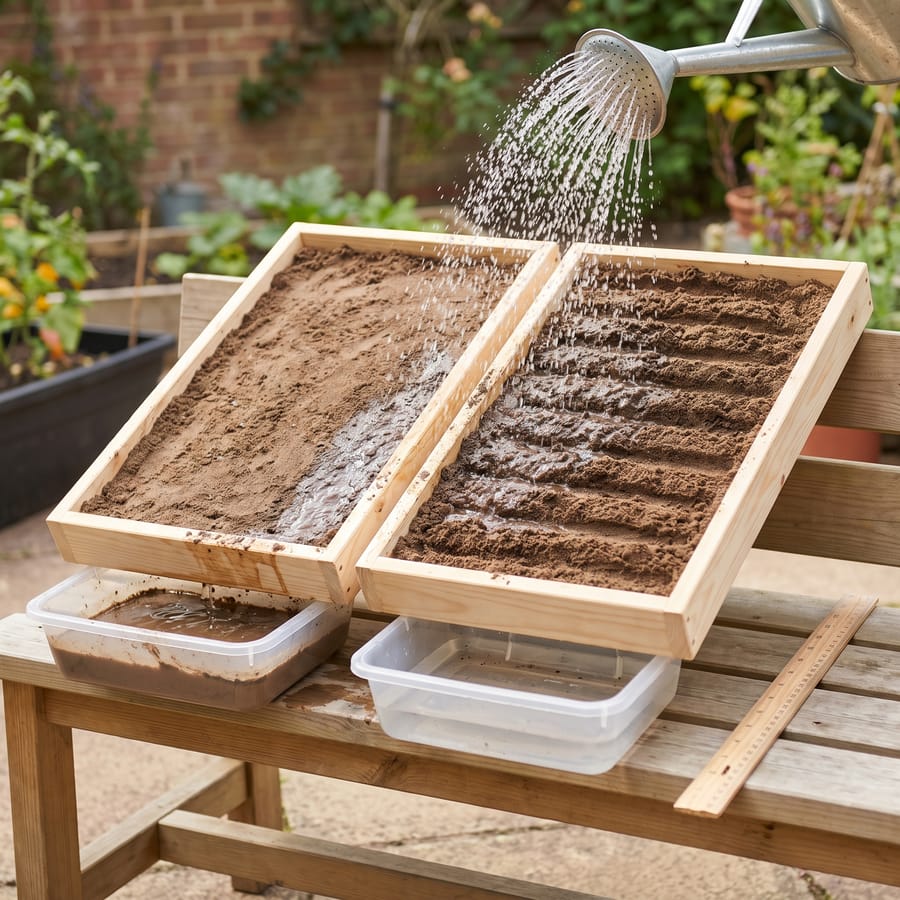
To make a soil erosion simulator and be able to answer the question “How do we prevent soil erosion?”
Theory & Background
Have you ever wondered about the amazing properties of water? When rain pours heavily, you may notice plenty of muddy water being carried away. Moving water moves soil particles. This process of carrying off soil particles by moving water and other agents such as wind is known as soil erosion. The amount of soil particles eroded by water depends on the type of soil. Sand is most easily eroded by falling rain followed by loam and clay. Sand is easily eroded because its particles are loose. Loam and clay stick together when wet. Moving water deposits the material they carry along the bank or as they enter a large body of water. The amount of material carried away increase as the flow of water becomes faster. When the flow of water is very fast, there is of course a greater ability of water to carry away the materials. The volume or amount of the moving also affects the amount of materials water carry away. Soil erosion can be very destructive and we must find was on how to prevent it.
Required Materials
- two wooden boxes of identical size and shape preferably 20cm x 20cm x 4cm.
- moist soil
- ruler
- pencil
- water
- can with holes in the bottom
- 2 medium basins
Estimated Time
Approximately 30 minutes
Step-By-Step Procedure
Prepare the two wooden boxes.
Pack the boxes with moist soil about three centimeters deep.
Elevate the box at 15° angle.
Use a ruler to make the surface even.
Make a wedge on one corner of the box.
Plow a series of horizontal ridges on the soil of box A using a pencil.
Make each ridge 1cm deep and 2cm away from the next ridge. Sprinkle 1 liter water of water on each box using a can with holes on its bottom.
Drain off the water for about 15 minutes. Use the basins to collect water from each box.
Place the basins on the table and let the soil particles settle at the bottom.
Measure the height of soil and water collected.
Experiment Tips
- Cover your area with newspaper. Be careful in collecting water from the boxes.
Observation
Which ridges washed away less soil and water? What do you think caused the difference?
Result & Conclusion
The horizontal ridges prevent formation of gullies or channels made by water. Less soil is eroded on horizontal ridges than on the vertical ones. Some of the most common ways to prevent soil erosion is through contour plowing, terracing, crop rotation, and strip cropping. Contour plowing uses horizontal ridges on a sloping field to help prevent rapid soil erosion. It is the process of plowing in furrows or narrow grooves following the contour of the land. Crop rotation is the process of alternately planting row crops and cover crops. This method helps conserve the nutrients in the soil. Strip cropping is the process of arranging bands of row crops and cover crops alternately. This holds the soil in place. Planting trees on slopes is also one effective way of preventing soil erosion.