

Theory & Background
Have you ever wondered about the amazing properties of water? Fog forms when a layer of warm, wet air forms close to the ground and another layer of cooler, drier air forms on top of the warmer layer. When the ground begins to cool down, the water droplets in the warm, wet air begin to condense to form fog. This type of fog is called radiation fog.
Required Materials
- Two soda bottles with necks about the size of an ice cube
- Two ice cubes about the size of the soda bottle necks
- Hot water
- Cold water
- Journal or logbook
Estimated Time
A few hours at most.
Step-By-Step Procedure
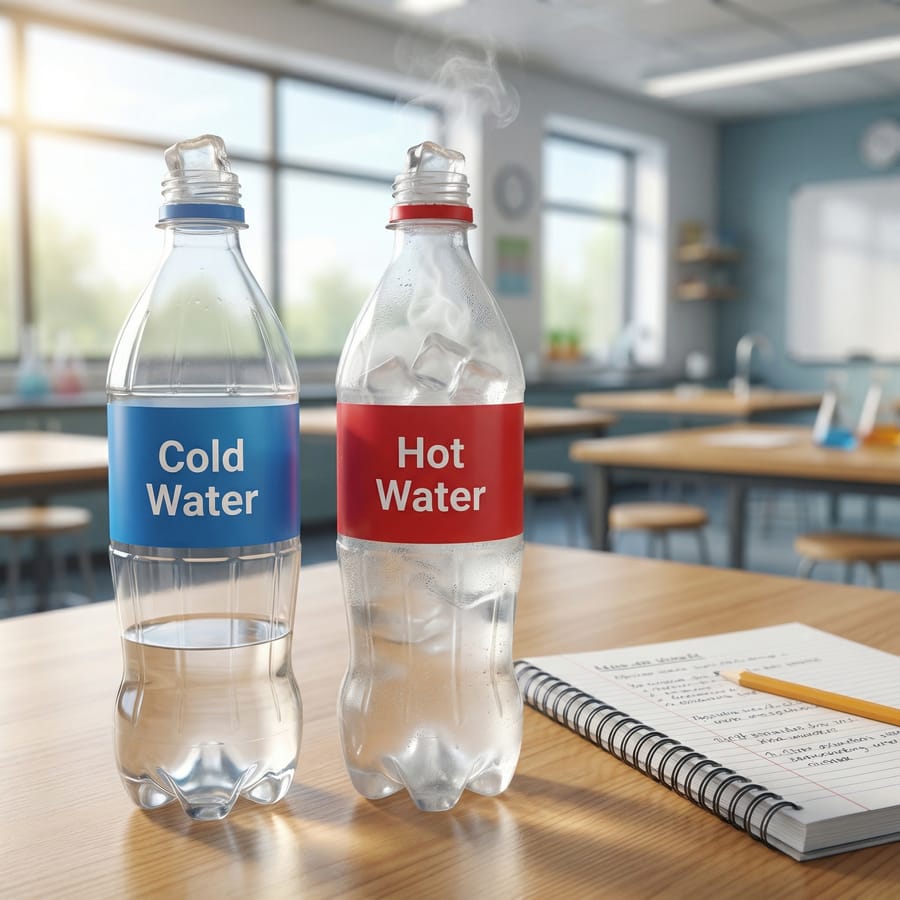
Empty the soda bottles and rinse them out thoroughly. Label each soda bottle, one with "Cold water" and the other with "Hot water."
Fill the first soda bottle ¼ of the way full with cold water. Place an ice cube in the neck of the soda bottle so it is wedged in but does not pass all the way through the bottle. What happens? Record your findings in your journal.
Repeat step two with the second soda bottle, only this time, filling the bottle ¼ of the way full with hot water. Place the ice cube in the neck of this soda bottle and note what happens.
Experiment Tips
- This experiment is an accurate simulation of radiation fog.
Observation
Watch what happens with each soda bottle and remember to record your findings in your journal or logbook. Fog will form in one of the bottles – make a prediction based on the description of how fog forms on which bottle will produce a simulation of fog. Which one do you think will produce the fog?
Result & Conclusion
Fog will form in the bottle with the hot water, but it will not form in the bottle of cold water. Why do you think that is? How does the description of how fog is formed relate to your findings? What do you think would happen if you repeated this experiment with several soda bottles with different temperatures of water? What do you think would happen if you used only warm water (not hot) or lukewarm (almost cool) water? Do you think more or less fog would form in the soda bottle? How do the results of the experiment apply to real life situations?