

Friction And Vibration
To determine if friction can cause a glass to vibrate. After this experiment you will be able to answer the question, “Why did the glass vibrate when you rubbed your index finger against the rim of the glass?”
Theory & Background
Have you ever wondered about this fascinating scientific process? Friction is a form of contact force. It is the force that acts against the motion of one surface on the other. Contact forces are resent when surfaces of objects act on each other like when the palms are rubbed or a pencil is pushed. When two objects are in contact, friction is present. Friction is necessary and very useful in some situations. The presence of friction is important in walking and in holding things together. For examples, screws and nails are held in place because of friction. Even adobe stones can be piled one on top of the other and won’t fall because of friction. Friction is present when two surfaces remain at rest and are in contact. When friction and the force causing the movement are equal in magnitude but opposite in direction, the object does not move. The amount of friction increases when objects move along a rough surface. On the other hand, the amount of friction decreases when objects move on a smooth surface just like when you add lubrication to make the surface slippery.
Required Materials
- Dishwashing liquid (any variant)
- Large pan
- Vinegar
- Water
- Thin glassware
- Small shallow bowl
Estimated Time
Approximately 10 minutes
Step-By-Step Procedure
Pour a generous amount of the dishwashing liquid to make a soapy water solution in a large pan.
Wash the glass and your hands in the soapy solution and rinse thoroughly.
Place the glass on the table.
In a small bowl, pour just enough vinegar where you can dip your finger.
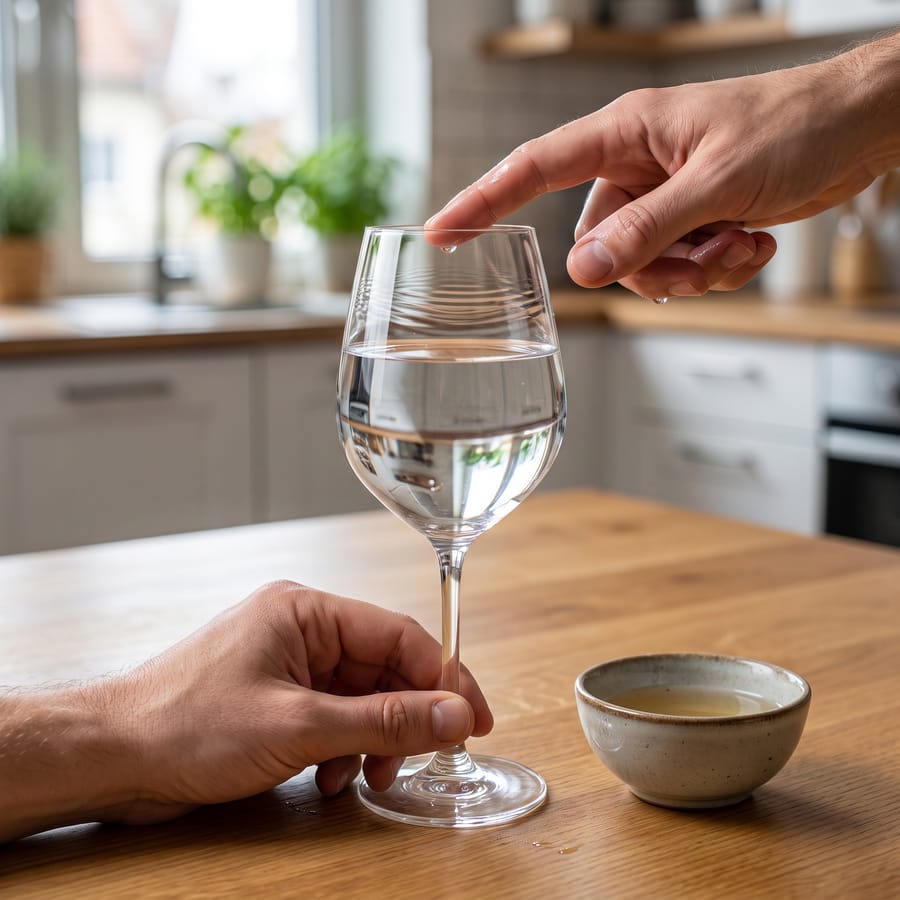
Hold the base of the glass against the table with your left hand.
Wet the index finger of your right hand with vinegar.
Using your wet index finger, gently rub it around the rim of the glass.
Experiment Tips
- Avoid spilling vinegar all over your work area by carefully pouring it on the bowl. Hold the glass firmly when washing it and rinse well to avoid slipping. Do not taste the vinegar or play with the water.
Observation
What happened when you rubbed the rim of the glass with your index finger? What were you trying to remove when you washed your hands and the glass? Is friction between your wet index finger and the glass increased or decreased? Why did the glass turn or vibrate when you rubbed your index finger against the rim?
Result & Conclusion
The rim of the glass vibrated because of the presence of friction which allows it to resist motion. You need to remove the dishwashing liquid which acts as lubricant by washing your hands thoroughly to decrease friction. In this experiment, friction resists motion which caused the glass to vibrate.