

Green Slime
To demonstrate how mixing two chemical together can form another chemical - slime!
Theory & Background
Have you ever noticed how light behaves in different situations? Slime, as defined by Webster’s dictionary, is: 1. thin, glutinous mud. 2. any ropy or viscous liquid matter, esp. of a foul kind. 3. a viscous secretion of animal or vegetable origin. Despite slime's grotesque characteristics and definition (the name alone is vile), many children and adults have a strange fascination and fondness for it, mostly due to toy companies creation of products that take on the characteristics described above, often with bright glowing hues of green. Manufactured "slime" is slightly wet to the touch, stretchy, bouncy, and usually large. In contrast, natural slime moulds are often brown, white, or yellow in color and are only a few centimeters small.
Required Materials
- White Wood glue (such as Elmer's brand)
- Borax powder (found in the laundry section of your local supermarket)
- Green food coloring
- Water
- Tablespoon
- Teaspoon
- 2 Bowls or containers
- Airtight container, such as a ziplock bag (to store your slime)
Estimated Time
Less than 10 minutes
Step-By-Step Procedure
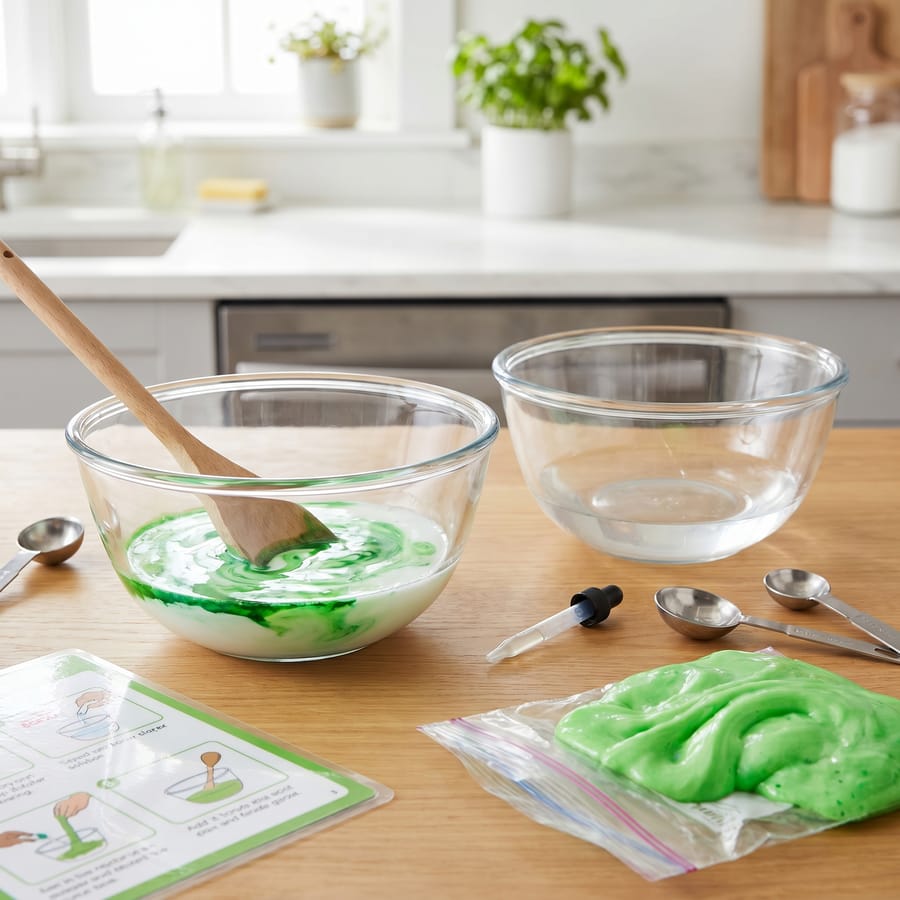
In a container, mix together one tablespoon of glue, one tablespoon of water, and one drop of green food coloring
In a separate container, dissolve one teaspoon of borax powder in one tablespoon of water.
Pour the borax solution into your glue mixture.
Use your fingers to mix the combined solutions - a "slime" should start to form instantly!
Store your slime in an airtight container, such as a ziplock bag, to avoid mold growth.
Experiment Tips
- You can add more of each ingredient if you want to make larger doses of slime. Just multiply the quantity of each ingredient and follow the same steps outlined in the experiment. You can also have some fun with the coloring by creating additional slime with red, yellow, blue, or any combination of food coloring. Borax powder is poisonous. Always make sure to wash your hands after handling it or handling your slime!
Observation
How does the final home-made slime compare to natural slime moulds? What happens to your slime if you continuously handle it and stretch it? What do you suppose would happen to your slime if you were to leave it out in the open, without storing it in an airtight container?
Result & Conclusion
The glue and the borax mix together to make a new form of chemical... the slime! The borax stops the glue flowing like a liquid. The resulting slime is very elastic and can be made into a bouncing ball! Give it a try!