

Hard vs. Soft Water
To determine the difference between hard and soft water by mimicking hard and soft water conditions.
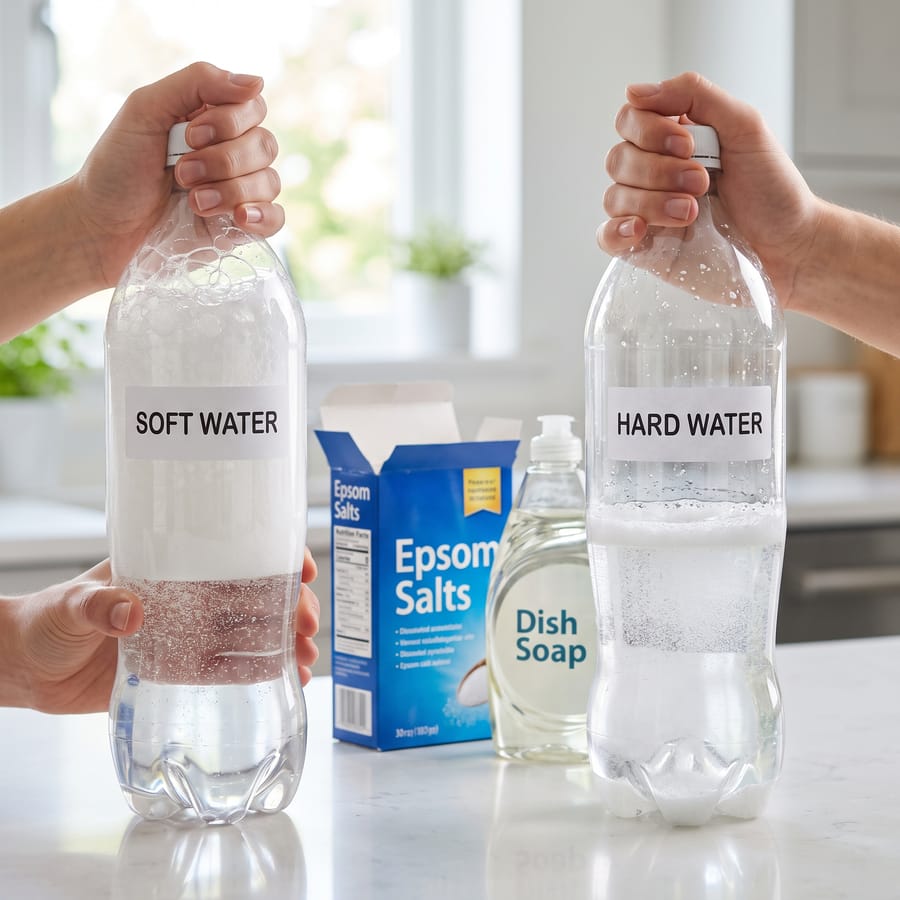
Theory & Background
Have you ever wondered about the amazing properties of water? Water with a high mineral count consisting mostly of calcium, magnesium, and other dissolved compounds, is "hard water". Calcium usually gets into the water in the form of chalk or limestone. Dolomite is usually the predominant source of magnesium found in hard water. One way to determine if your water is hard is to check how it lathers. When mixed with soap, hard water will have a difficult time lathering. In contrast, soft water will lather / froth easily.
Required Materials
- 2 empty soda bottles of the same size with caps (20 oz kind)
- Epsom salts
- Dishwashing liquid
- Water
Estimated Time
Less than 10 minutes
Step-By-Step Procedure
Add two cups of water to each soda bottle.
Add two teaspoons of Epsom salts to one of the bottles. Screw the cap onto the bottle and shake vigorously for a few seconds.
Open the bottles by removing the caps. Add a few drops of dishwashing detergent to each bottle. Replace the bottle caps. Shake both bottle vigorously for a few seconds.
What do you notice happens?
Experiment Tips
- Having difficulty locating the Epson salts? Don't worry! Epsom salts are quite common and easily found in the laundry section of your local supermarket.
Observation
Can you think of other minerals you can add to the bottle of water to make it hard? What do you think you can add in addition to the detergent to make the water soft?
Result & Conclusion
The bottle with the Epsom salts should have far less bubbles than the bottle without Epsom salts. This is because you made the water "hard". Water in many areas is hard because it has minerals dissolved in it. These minerals interfere with the action of detergents. Chemicals can be added to hard water to make it "soft" again, so the detergents can do their job.