

Home-made Stethoscope
To demonstrate how sound waves can travel through enclosed spaces and become aplified by creating a home-made stethoscope.
Theory & Background
Have you ever wondered about this fascinating scientific process? The stethoscope was invented in 1816 by French physician and inventor René-Théophile-Hyacinthe Laennec. The idea came to Laennec when he witnessed children playing with a long piece of wood that transmitted the sound of pins scratching the surface. After making the observation, the next day he rolled up a piece of paper into the shape of a funnel. He then used it to listen to the chests of his patients. Discovering the funnel amplified the sounds from his patients chests, Laennec (who had a background in carpentry) built a 25cm by 2.5cm hollowed wooden cylinder. This cylinder replaced the rolled up paper tube as a device to listen to his patients chest. He later modified this device with detachable parts. He notated the various sounds he heard with his primitive stethoscope and related them to anatomical findings at his patients autopsies. He published his findings in 1819 and the stethoscope, derived from the Greek word "stethos" (meaning chest), was born. As he neared death Laennec often referred to the stethoscope as "the cylinder" and bequeathed his own stethoscope to his nephew, accurately referring to it as the "the greatest legacy" of his life.
Required Materials
- 2 Funnels
- Old garden hose (it will need to be cut-up)
- Scissors
- Modeling clay
- Pen or pencil
- Journal
Estimated Time
About 15 minutes
Step-By-Step Procedure
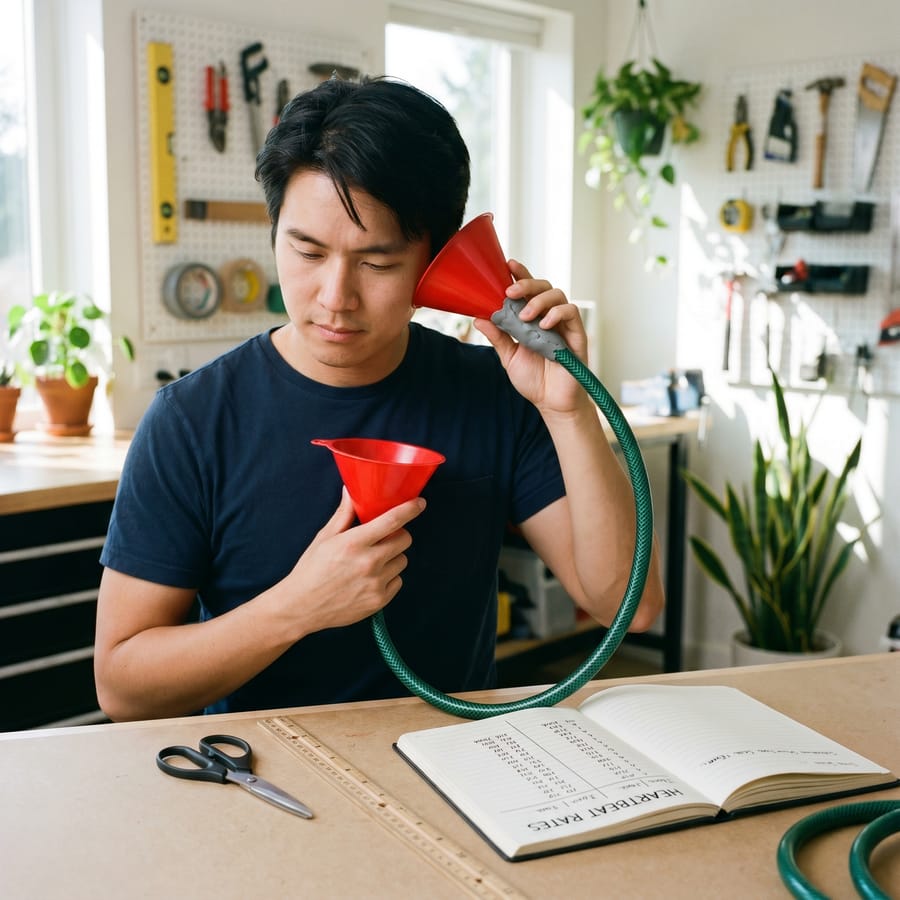
Use your scissors to cut a piece of garden hose approximately 16 inches in length. Make sure to cut from the middle of the house as you'll need both ends to be even (don't use the end that connects to outdoor faucets).
Place one of the funnels onto the end of the garden hose. If it doesn't fit tightly, use some modeling clay to secure it.
Repeat step 2 with the other funnel on the other end of the garden hose.
Place one end of the funnel over your heart and the other end over your ear. What do you hear? Count your heartbeat rate for 30 seconds and note them in your journal.
Do some jumping jacks, run around, exert a lot of energy for about 1 minute.
Use your stethoscope again, with one end over your heart and one end to your ear. Now what do you hear? Again count your heart beat rate for 30 seconds and note them in your journal.
Experiment Tips
- If you're having trouble cutting the garden hose with a scissor, you may need to use a sharp knife or razor. As always, make sure you have the help of an adult when cutting objects!
Observation
Can you think of other materials you could use to create a home-made stethoscope? What other purposes, beyond listening to your heartbeat, can you find for the stethoscope?
Result & Conclusion
Stethoscopes can measure the rate of your heart and assist in determining how many times your heart beats per minute. The stethoscope works on the simple principle of acting as a sound amplifier that carries the sound along the hose to your ears.