

Inertia of an Egg
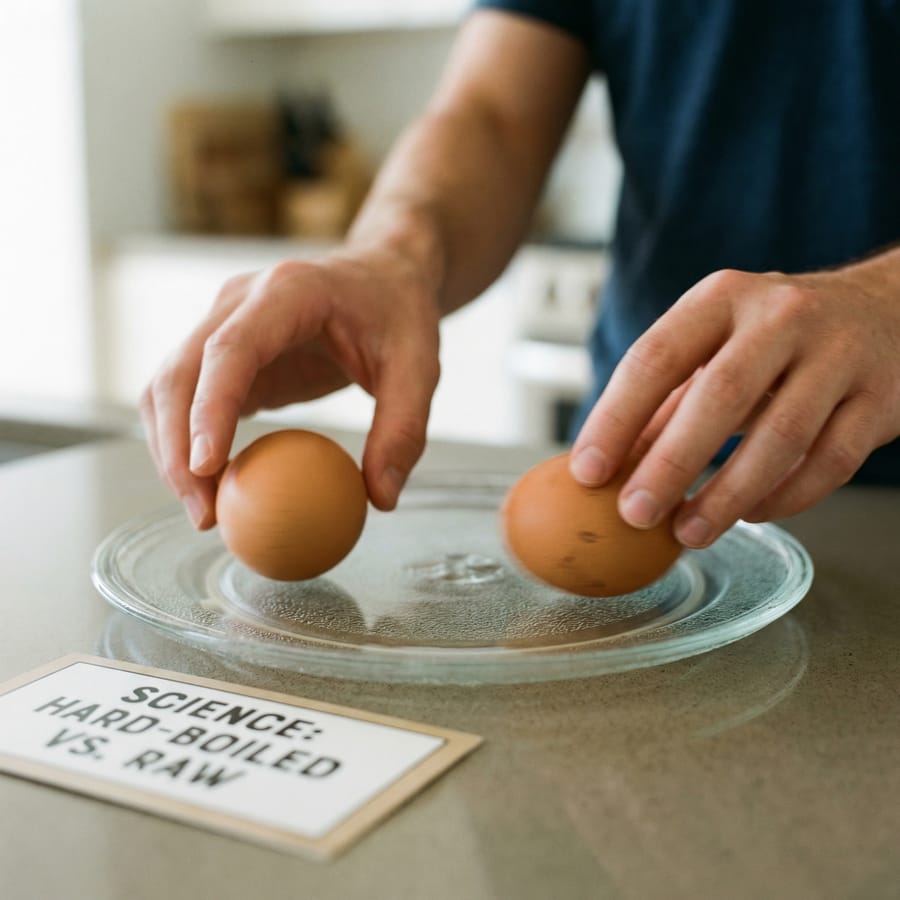
To identify a hard-boiled egg from among a dozen, the remainder being uncooked eggs and thereby demonstrate the Inertia of an Egg
Theory & Background
Have you ever wondered about this fascinating scientific process? Inertia is defined as the property of matter by which it resists changes in velocity (speed and / or direction). The tendency of a moving object to remain moving at a constant speed and a stationery object to remain motionless is called inertia.
Required Materials
- Raw & boiled eggs
- Glass plate
Estimated Time
Less than 5 minutes
Step-By-Step Procedure
Spin each egg and then touch the egg to stop it moving and let go.
Observe how each spun egg behaves.
Experiment Tips
- N/A
Observation
The hard-boiled egg will spin readily and stops soon after it is touched. But the fresh egg is difficult to get spinning and once it starts moving it is difficult to stop it from moving.
Result & Conclusion
Only the hard boiled egg spins readily since the mass inside it is solid and evenly distributed. In the case of the raw egg, the liquid within causes a drag effect that resists the spin initially and once the liquid is moving it resists coming back to the state of being motionless. The egg that spins readily and comes to a stop as soon as it is touched is the hard-boiled egg hence.