

Make a Parallel Circuit
To construct a parallel circuit. After this experiment, you will be able to construct your own parallel circuit and answer the question, “Why are the electrical devices and appliances in the home commonly connected in parallel?”
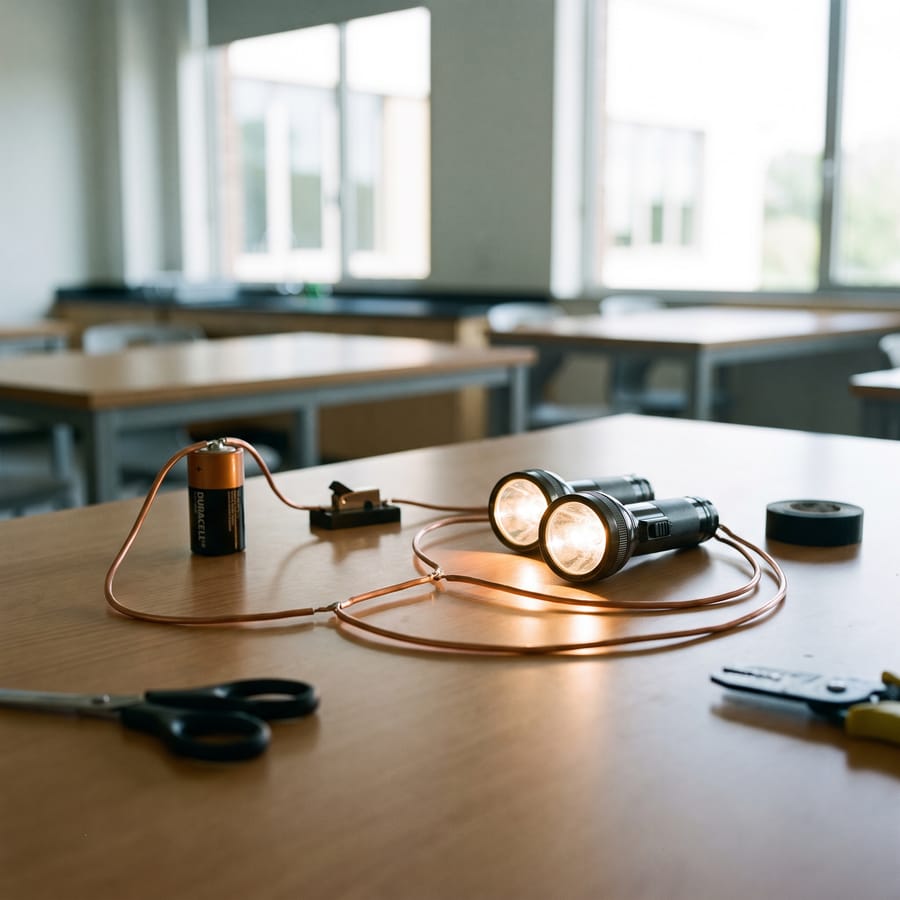
Theory & Background
Have you ever wondered about this fascinating scientific process? You can connect two or more bulbs or appliances in a circuit. There are two basic ways to connect electrical devices like bulbs in a circuit. The devices can be connected through series or parallel wiring. In a series connection, electricity flows through each electrical device. A problem arises if one device used in the circuit fails to function correctly and will stop the flow of electricity. No part of the series circuit can be switched on or off without affecting the other devices connected to the circuit. On the other hand, in a parallel circuit the electric current flows and only part of the total current in the circuit goes through each bulb or electrical device. Each has a circuit of its own so the electric current flowing through each device moves in a different path in the circuit.
Required Materials
- two flashlight bulbs with sockets
- dry cell
- half a meter copper wire
- electrical tape
- switch
- scissors
Estimated Time
Approximately 20 minutes
Step-By-Step Procedure
Cut the wire into five parts.
Remove half a centimeter of insulation from both ends of the wires.
Attach a wire to the positive side of the dry cell and wound the other end to the left side of a light bulb.
Attach another wire to the negative side of the dry cell and connect it to the switch.
Get another wire and connect the switch to the right side of the light bulb.
Add one more bulb to the setup by wounding another wire to the left side of the first light bulb and connecting the other end to the left side of the second light bulb.
Wound another wire to the right side of the first light bulb and connect it to the right side of the second light bulb.
Experiment Tips
- In removing insulations, do it slowly and carefully to avoid damaging the wires. Secure your connections with electrical tapes. Do not play with the light bulbs since they are easily broken.
Observation
Does adding a bulb in the setup affect the brightness of the bulb? What happened when you remove one of the light bulbs? Why does turning off one light bulb not break the circuit? Why is parallel circuit better than series circuit?
Result & Conclusion
When you added one more light bulb to the circuit, it did not affect the brightness of the first light bulb. The connection was not broken even when you removed one of the light bulbs in the circuit. The circuit did not break because a parallel circuit has more than one pathway for the electricity. This way, it is better than series circuit since the devices can be switched on and off separately without breaking any circuits.