
Microbial Contaminants
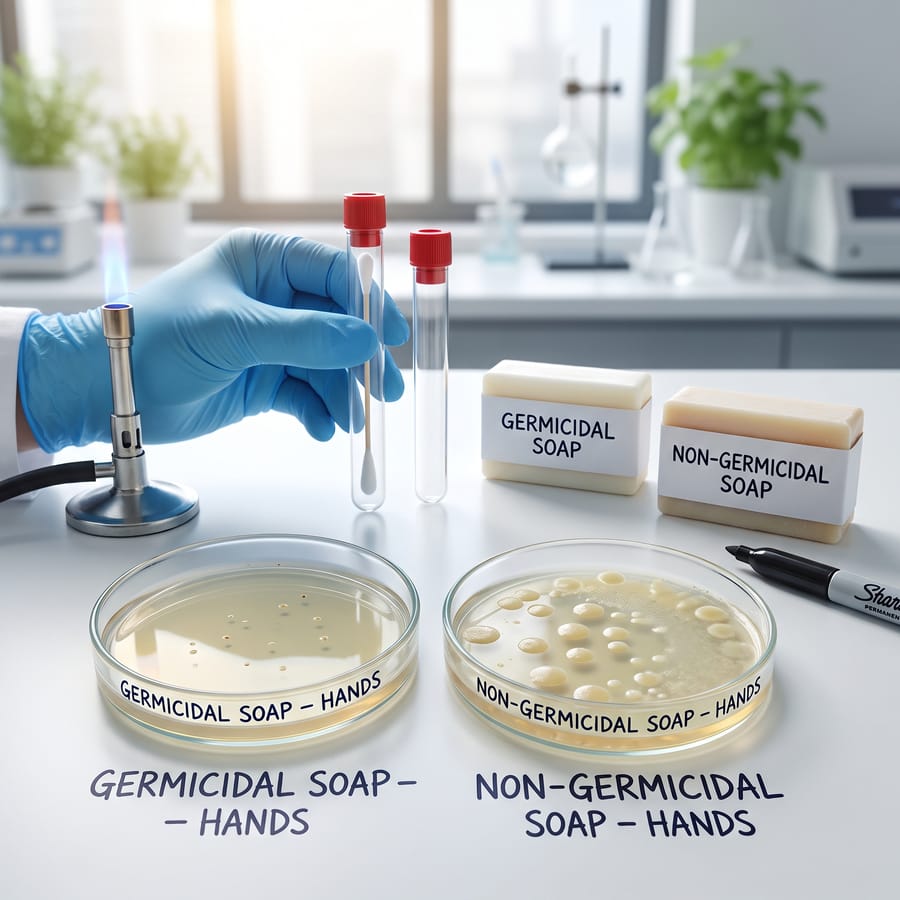
To compare the ability to remove microorganisms by germicidal soaps and non germicidal soaps.
Theory & Background
Have you ever wondered about the amazing properties of water? There are two types of microbial flora on our skin; resident flora and transmitted flora. Resident flora lives permanently on our skin. Most of the skin residing microorganisms feed on skin secretions and live in harmony. They cause no diseases or adversary conditions to humans. But some of them are opportunistic pathogens. Means although they live in harmony, they can cause adversities to humans when an individual is deprived of natural immunity; especially when suffers with another disease condition. Resident flora is an essential part of our skin. They even help us to protect from skin pathogens by competitive inhibition. Transmitted flora contaminates our skin when we make contact with other objects, soil, water or air. By washing, we can easily remove transmitted flora but resident flora removes only after a thorough washing.
Required Materials
- Four sterile cotton buds
- Sterilized Petri dishes
- Sterilized pipettes
- Sterilized test tubes with stoppers
- Sterile distilled water(or you can use sterile peptone water as your diluent)
- Pipette bulbs
- Bunsen burners
- Permanent marker
- Sterile liquid plate count agar medium
- Two soaps. Each from a germicidal brand and a non germicidal brand.
- vortex
Estimated Time
Sterilization of require materials – 3 hours To carry out the experiment – about 3 hours Incubation period – 2 to 3 days
Step-By-Step Procedure
Prepare all the sterilized glass ware and microbiological media (in this case “total plate count agar”) prier to the experiment. a. Wrap all the glass instruments individually (pipettes and Petri dishes can wrap into sets) with news papers or aluminum foils. Put them inside a hot air oven. Heat them at 160°C for about three hours to sterilize. Total Plate count Agar*1 in conical flasks (plugged with non absorbent cotton wool swabs covered with foil paper or screw caps) must place in an autoclave to be sterilized at 120°C for about 15 minutes. Place each cotton bud in a test tube. Plug the tubes. Sterilize using the autoclave.
Experiment Tips
- *1 You can prepare “Total Plate Count Agar” by following the instructions given in the label of commercial TPCA medium bottle or prepare the medium manually by following the recipe given in general microbiology books or microbiological media composition manuals. *2 Metal objects like scissors can be sterilized by boiling or simply dip it in alcohol and flame a second until the alcohol layer on the object burns . *3 Decant 1ml from the zero dilution into a test tube containing 9ml of sterile distilled water (in sterile conditions). Plug the test tube. Mix thoroughly. Name the tube as 10-1dilutiion. Likewise using a 1 ml from 10-1dilutiion, prepare 10-2 dilution. Continue the procedure until you get a dilution series up to 10-8. *4 Pipette out 1 ml from 10° dilution into a Petri dish labeled as °. Repeat this with other dilutions. Do not forget to label the plate with the other information as from which hand you took the sample, what is the media that you add inside, date …etc. Mark these details in the bottom edge of the Petri dish (not on the lid). Use abbreviations. Usually we place liquid agar media in 50°C incubator to keep them as liquids. Keep until cool down to about 40°C. Pour approximately 15 ml of nutrient agar in to each of the plates containing 1ml of microbial solutions. Mix the medium and culture in Petri plate by slowly applying circular (clockwise and anti clockwise) and linear (back and fore) moments.
Observation
After the calculations you will see that the germicidal soap removes more bacteria than the non germicidal soap.
Result & Conclusion
Did you know that the meaning of “germicidal” is killing germs? Germicidal soaps contain antimicrobial agents to kill microbial contaminants on our skin. Therefore they are more effective in removing microorganisms than non germicidal soaps. But you don’t have to remove non germicidal soaps from your bath rooms. Remember, the resident flora lives in harmony with us. Removing all the friendly microorganisms can cause health problems. Germicidal soaps are useful to get our selves clean after doing works and playing outdoors, before food processing, before doing operations by doctors...etc.