

Oral Bacteria
The purpose of this experiment is to determine if the mouth of a canine has more or less bacteria than that of a human’s.
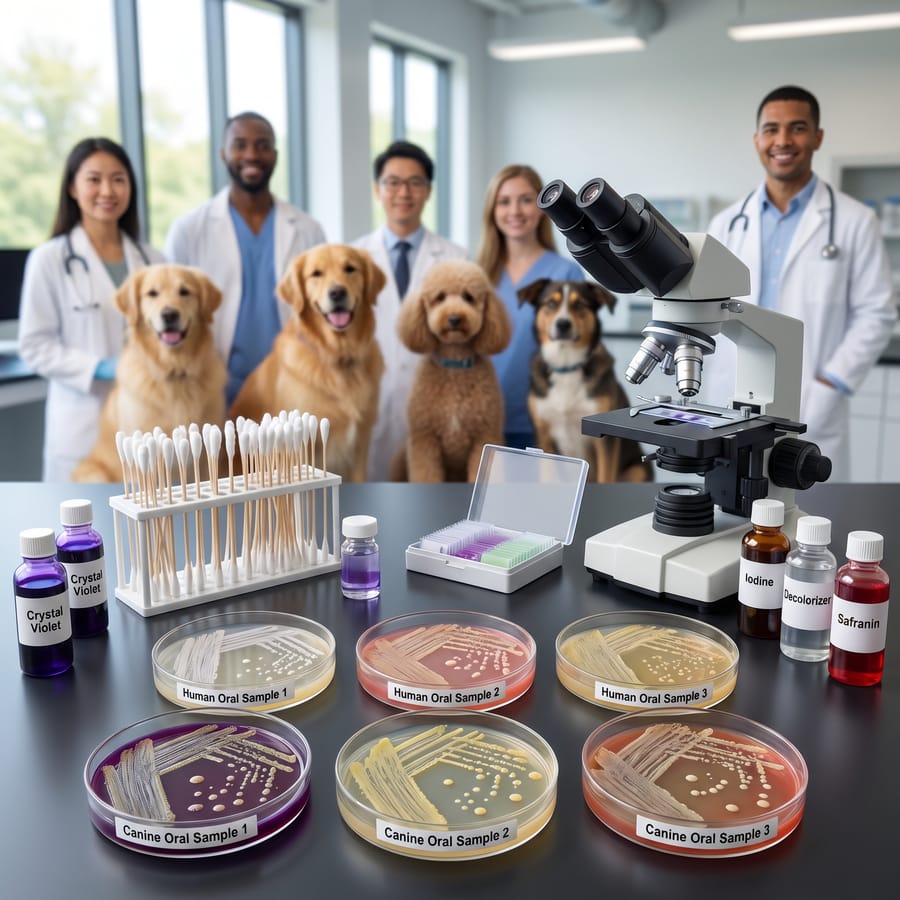
Theory & Background
Have you ever wondered about this fascinating scientific process? You’ve probably heard people say that a dog’s mouth is cleaner than a human’s mouth because of the enzymes present in their saliva. Logic, however, tends to make this theory less believable due to the way that a dog eats, takes a bath and the fact that they are unable to clean their mouths with toothpaste or mouthwash like a human can. At the end of this experiment, you will be able to prove or disprove the theory that a dog’s mouth is cleaner than a human’s.
Required Materials
- Six Petri dishes (premade Petri dishes will be faster than if you prepare agar and pour it in empty dishes)
- Petri dish labels or permanent marker for labeling of specimens
- Three canine volunteers
- Three human volunteers
- Sterile, individually wrapped cotton swabs
- Microscope (you can ask your science teacher permission to use the school microscopes)
- Microscope slides
- Stain to color your specimens and make them easily viewable through the microscope
- Journal or notebook paper for logging your observations
Estimated Time
About 24-48 hours.
Step-By-Step Procedure
Gather the labeled Petri dishes, the cotton swabs, the canine volunteers and the human volunteers.
For the first volunteer, unwrap the cotton swab and use the cotton tip to swab inside their cheek and around their gums. Swirl the cotton swab onto the corresponding Petri dish.
Repeat step two for all canine and human volunteers.
Place the Petri dishes in a dark, warm environment for about 24 hours.
After the designated amount of time, remove the Petri dishes and gather your microscope slides, stain and more cotton swabs.
Use the cotton swab to transfer bacteria from the Petri dish to the slide and use the stain.
Proceed to view the amount of bacteria on each slide and record your findings in your journal or on notebook paper.
Experiment Tips
- Some items, such as the Petri dishes, can be found at any biological supply or science supply store.
Observation
You will need to count the number of bacteria on the slide. You can count the bacteria in a square centimeter and multiply that amount by the total square centimeters on the slide.
Result & Conclusion
The result you get depends on your findings. Which individual specimen had the greater number of bacteria? Based on your findings, which group – humans or canines – have more bacteria in their mouth? After the experiment, what is your stance on the theory that a dog’s mouth is cleaner than a human’s?