

Pangaea Puzzle
To discover the evidence for continental drift by fitting the continents together like a jigsaw puzzle.
Theory & Background
About 300 million years ago, all of Earth’s continents were joined together in one giant supercontinent that scientists call Pangaea. Over millions of years, slowly moving tectonic plates carried the continents to where they sit today.
One big clue that this really happened is that the coastlines of the continents — especially the east coast of South America and the west coast of Africa — look like they would fit together like puzzle pieces. Matching fossils and rock layers found on continents now separated by oceans are even more clues.
Required Materials
- A printed world map showing all the continents
- Scissors
- A sheet of colored construction paper
- Glue or tape
- Colored pencils
Estimated Time
About 45 minutes to 1 hour
Step-By-Step Procedure
Print or draw a world map that clearly shows all seven continents.
Carefully cut out each continent along its coastline, leaving out the oceans.
Spread the cut-out continents on your desk and study the shapes of their edges.
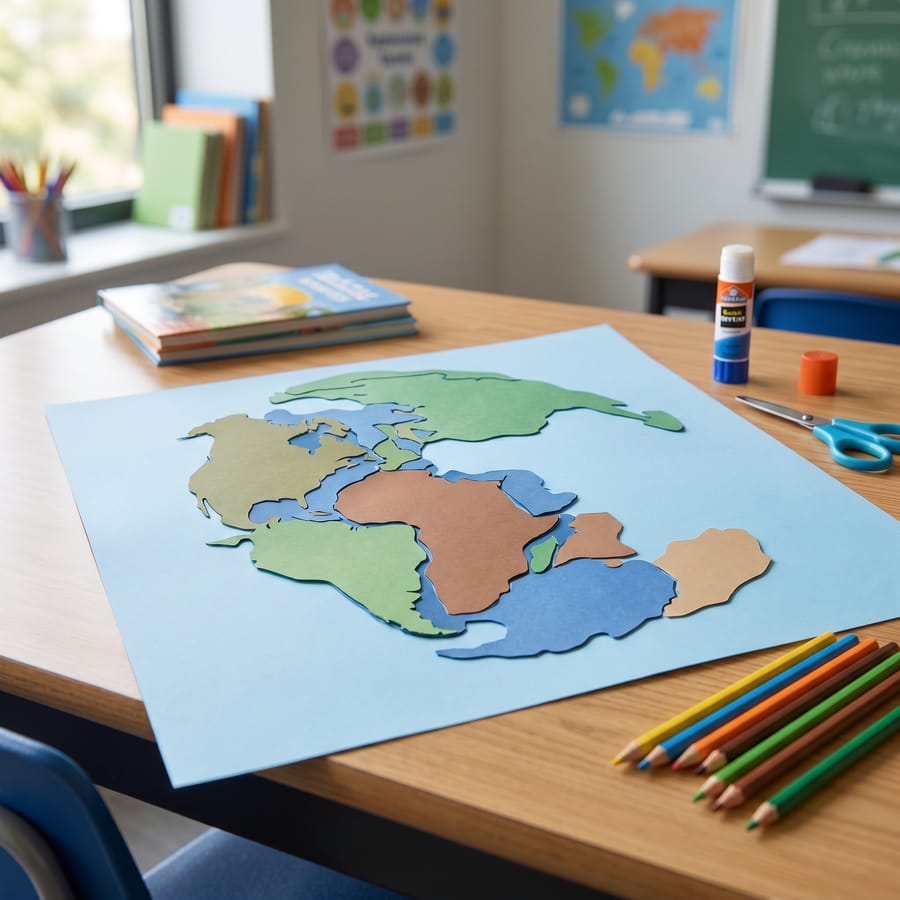
Fit the pieces together into one big landmass, just like solving a jigsaw puzzle. Start with South America and Africa — their edges match closely.
Once you’ve assembled your best “Pangaea,” glue it onto the colored paper.
With colored pencils, draw matching bands across continents that were joined, to stand for the matching fossils and mountain ranges scientists have found on both sides.
Compare your reconstructed supercontinent to a real map of Pangaea.
Experiment Tips
- Focus on the shape of the continental shelves (the true underwater edges), not just the visible coastline — that’s what actually fits together.
- Look up which fossils, like the reptile Mesosaurus, have been found on continents now separated by whole oceans, and mark where they were discovered.
Observation
The continents — especially South America and Africa — fit together surprisingly well, closing the ocean gaps between them and forming one large, connected landmass.
Result & Conclusion
The pieces fit because the continents really were once joined and have slowly drifted apart — powerful evidence for the theory of plate tectonics. Matching coastlines, fossils, and rock layers across oceans all point to the same conclusion: Earth’s surface is always slowly moving, and the same plate motion that broke up Pangaea still causes earthquakes and builds mountains today.