

Theory & Background
Have you ever wondered about this fascinating scientific process? Volcanoes are located continental and oceanic plates meet. The plates collide with one another as they float within the earth's interior on molten rock, resulting in the release of an enormous amount of energy. As the rocks in the lower plate melt, additional magma is created within the Earth's interior. This magma, which is mixed with various gases, accumulates until the pressure is so great that it causes a massive eruption through the fissures in the earth's surface. Volcanoes are essentially openings or vents through which the magma and dissolved gases are discharged. One of the earliest detailed reports of a volcanic eruption was by Pliny the Younger. Pliny wrote about the eruption of Mount Vesuvius in AD 79, which caused the destruction of Pompeii. Pompeii is undergoing excavation today to discover information on the Roman lifestyle.
Required Materials
- Metal funnel
- Modeling clay
- Medium-sized skillet
- Water
- Stove-top
- Oven mitt (or heat-resistant gloves)
- Goggles (recommended for eye protection)
Estimated Time
About 10 minutes
Step-By-Step Procedure
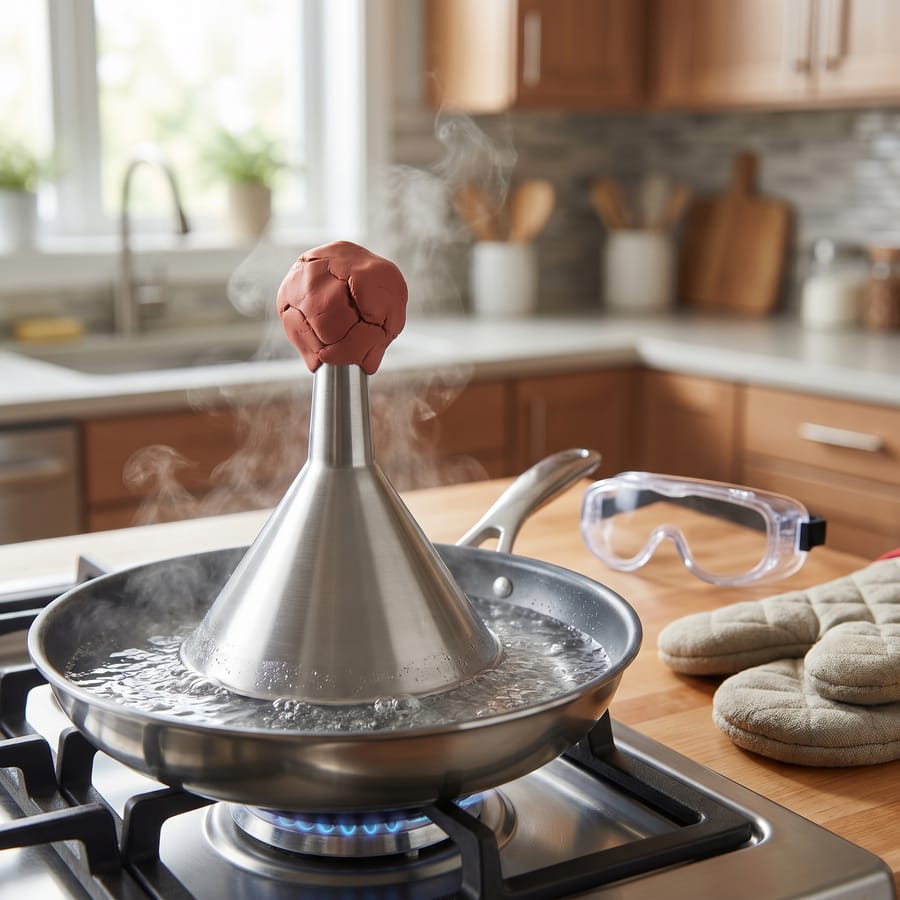
Take your metal funnel and apply a small amount of modeling clay to cover the hole on the narrow end. It should form a "cork" using a thin strip of clay.
Fill the skillet about 1/3 full with water.
Place the skillet on a burner on your stove-top.
Heat the water in the skillet at a medium setting.
Place the funnel, wide end down, in the center of the skillet.
Turn the heat up to high and stand back (wear your goggles for safety from flying clay)!
Experiment Tips
- The funnel will become VERY hot! Use your oven mitt to remove the funnel from the skillet when the experiment has ended. Seek the help of an adult for this experiment! You should wear your safety goggle at all times as the strength of the eruption may vary.
Observation
Think of ways you could improve your volcanic eruption. Is there anything you could add to enhance the eruption?
Result & Conclusion
As the water heats up, it creates vapor (gas) that is pushed up into the funnel. The pressure that builds inside the funnel is similar to the pressure caused by the magma and gases within a volcano. When the pressure becomes too great for the funnel, the clay cork "pops" and flies off the funnel, simulating a volcanic eruption.