

Refraction in Water
To demonstrate the principle of refraction of light rays in water.
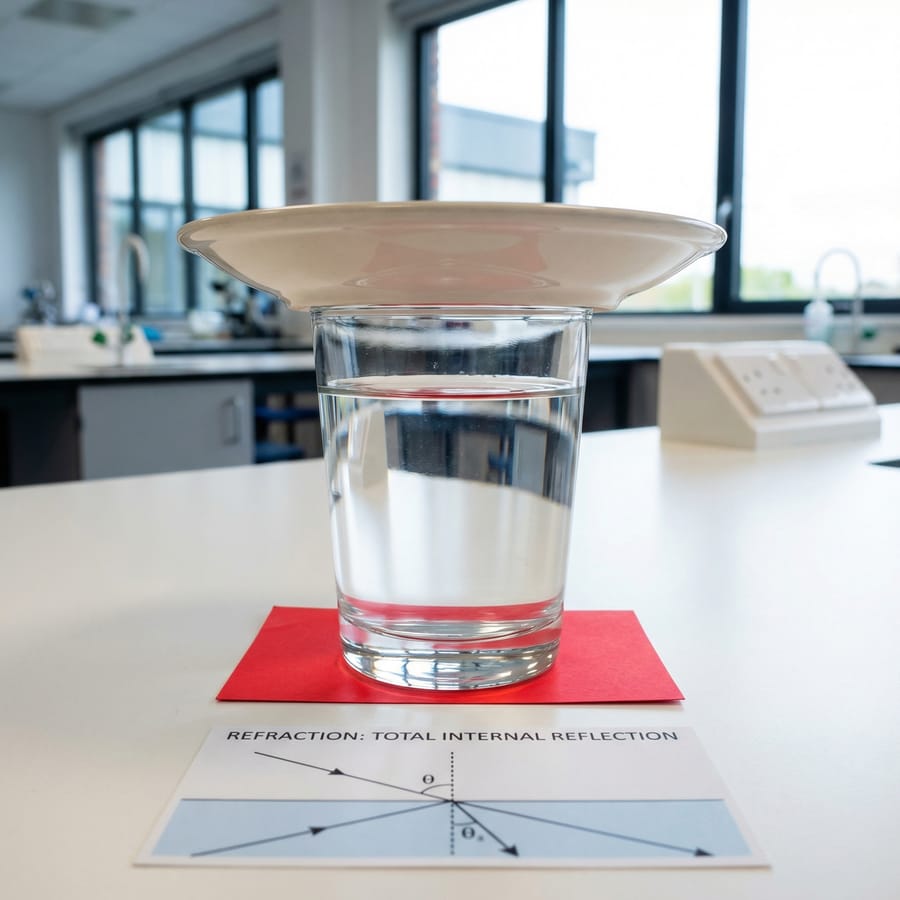
Theory & Background
Have you ever noticed how light behaves in different situations? Refraction is the process by which a wave bends when it enters a different medium owing to an alteration in the speed at which it travels. As light passes from one transparent medium into another, it changes speed and bends as a result of this. The extent of bending depends on the ‘refractive index’ of the medium as well as the angle between the light ray and the line perpendicular to the surface (known as the ‘normal’) separating the two mediums (or the ‘medium interface’.) Each medium has a different refractive index; the angle between the light ray and the normal as it enters a medium is called the ‘angle of refraction’, while the angle between the light ray and the normal as it leaves a medium is called the ‘angle of incidence’.
Required Materials
- Glass tumbler
- Piece of colored paper
- Saucer
Estimated Time
Less than 5 minutes
Step-By-Step Procedure
Take a glass tumbler and fill it with water
Place a small piece of colored paper on a table before placing the glass tumbler containing water over it
Cover the glass with a saucer
Try to look at the colored paper placed under the tumbler
Experiment Tips
- The saucer must be wide enough to cover more area than just the mouth of the tumbler.
Observation
The colored paper vanishes, and is invisible irrespective of the angle from which it is looked at.
Result & Conclusion
This is due to the phenomenon of ‘refraction’ or the bending of light rays when they pass at an angle from one medium to another. Light rays falling on the paper get refracted and bend upward as they pass from water to air. The refracted rays are unable to emerge from the tumbler since its path is blocked by the opaque saucer. Thus the colored paper can't be seen from any angle and it appears to vanish.