

Separate Salt And Pepper
To demonstrate how static electricity can be used to separate pepper from a salt and pepper mix.
Theory & Background
Have you ever wondered about this fascinating scientific process? All matter is made up of tiny atoms, which in turn are made of even smaller parts called protons, electrons and neutrons. While protons have a positive (+) charge, electrons have a negative (-) charge and neutrons have no charge at all. Usually, atoms have the same number of electrons and protons making them devoid of any charge or ‘neutral.’
Required Materials
- Comb
- Salt
- Pepper
- Cloth or material that can create a strong static charge, preferably wool.
- Inflated balloon (optional)
Estimated Time
Less than 5 minutes
Step-By-Step Procedure
Shake some salt onto a flat surface with a table cloth.
Shake some pepper over the salt.
Mix the salt and pepper together with your fingertips until there is an even mixture of salt and pepper.
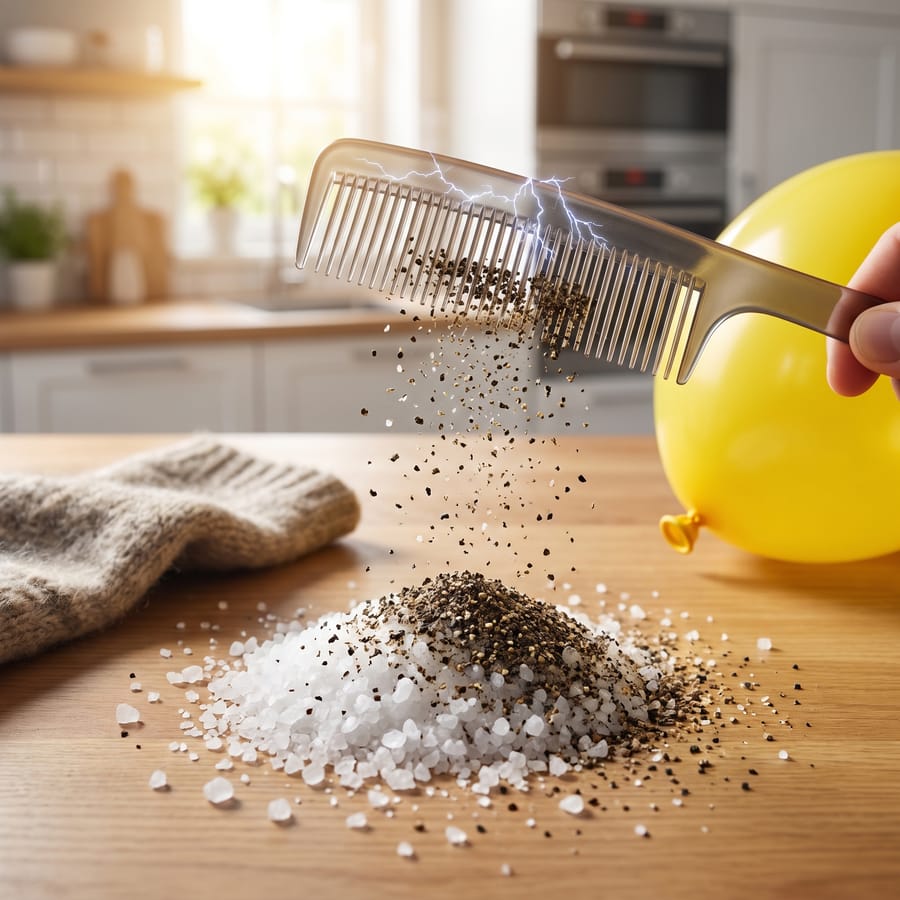
Set your comb with a static charge by rubbing it against some cloth or your inflated balloon (if you have one).
With your comb charged slowly lower it above the salt and pepper mixture, teeth side down until it's about 1 inch away.
Like magic the pepper particles separate from the salt particles and cling to the comb!
Experiment Tips
- Be careful not to get salt or pepper in your eyes. You may want to wear safety goggles to ensure 100% eye protection.
Observation
What would happen if you were to charge the balloon against the wool or cloth and then use that in place of the comb? What would happen if you quickly moved the balloon over the mixture? What if you got really close to the mixture?
Result & Conclusion
When the comb is rubbed against the cloth or balloon, it becomes negatively charged. The salt and pepper are both positively charged, which means they will form a natural attraction to the static from the comb. When the comb is slowly placed above the mixture, the pepper particles fly up and attract. Why do the pepper particles attract while the salt doesn't? Pepper particles are much lighter than the salt, so they're quicker to attract to the comb. If you were to bring the comb closer to the mixture, the heavier salt would eventually cling to it as well.