

Spectrum through Water
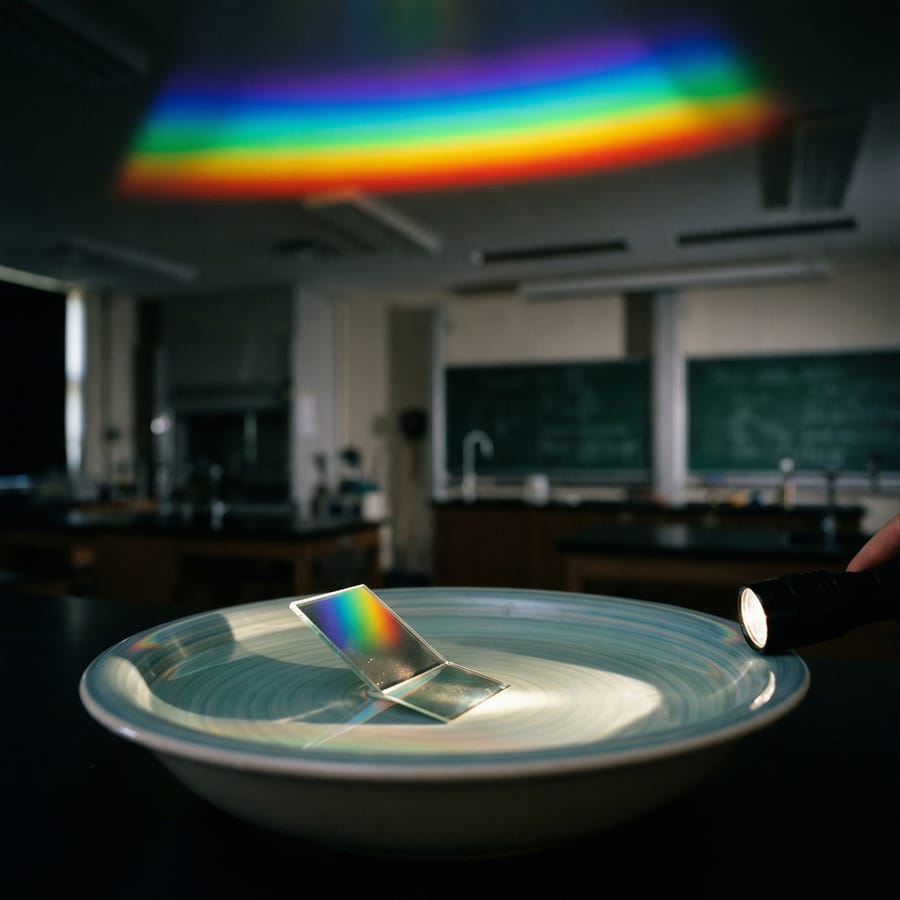
To create a spectrum using a beam of light passing through water
Theory & Background
Have you ever noticed how light behaves in different situations? A glass simple prism can be used to split a beam of white light into its component colors. The process due to which white light splits into component colors is called dispersion.
Required Materials
- Shallow bowl
- Water
- Mirror
- Torch
Estimated Time
Less than 5 minutes
Step-By-Step Procedure
Fill a shallow bowl with water
Place a mirror in this shallow bowl containing water so that it is at an angle of about 30 degrees to the surface of the water
Make the room dark (switch off lights / cover windows with dark cloth or paper)
Shine the torch on the mirror
Experiment Tips
- The angle at which the mirror is placed is crucial to the formation of the spectrum on the ceiling.
Observation
When a beam of light from the torch is shone on the mirror immersed in water, a small spectrum of rainbow colors appears on the ceiling.
Result & Conclusion
The experiment proves that white light is composed of different colors of the spectrum, each possessing different wave lengths. Each water molecule acts as a simple prism causing the refraction of each wave length of light at a different angles ultimately leading to the formation of the colors of the spectrum on the surface on which the reflected beam of light falls.