

Theory & Background
Did you know that air around us has incredible properties? Porous materials allow air and liquid to be absorbed. Interestingly enough, rocks in themselves are porous! Which are the most porous and which are not? That's the basis for this experiment and for you to discover.
Required Materials
- 3 large clear containers of the same size (such as drinking glasses or jars)
- Measuring cup
- Water
- Piece of granite
- Piece of sandstone
- Piece of limestone
- Tape (optional)
Estimated Time
About 35 minutes.
Step-By-Step Procedure
Measure and pour an equal amount of water into each of the three containers. Make sure there is enough water so that each rock will be submerged completely.
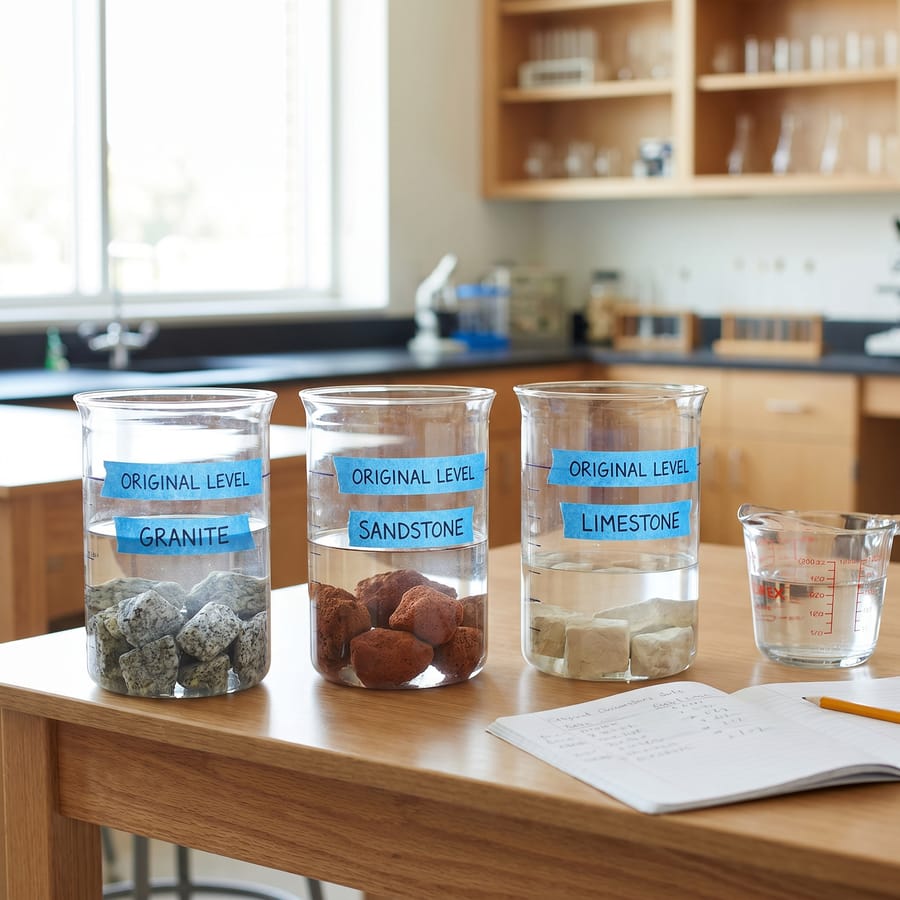
Make note of the amount of water poured into the containers. You can do this several ways. The first is to note how much water was in your measuring cup. Another method is by marking the water line with a piece of tape on each container (recommended).
Put one rock in the middle of each water-filled container.
Leave the containers undisturbed for at least 30 minutes.
After 30 minutes pass, observe the glasses. Can you see anything happening to the water levels?
Carefully remove the rocks from their containers. Make sure to allow all the excess water to drain into the container!
Calculate how much water was soaked up by each rock. This can be done by pouring the remaining water from the container back into the measuring cup and subtracting the volume from the original volume. If you used tape as a marker, you can note the water level in relation to your tape marker.
Experiment Tips
- If you're having a difficult time finding the rocks mentioned in this project, refer to the following chart for examples of the rocks. Granite Sandstone Limestone
Observation
Try this with various types of rocks, notating in a journal the ones that "drink" the most water. Can you think of other things, besides rocks, that you could conduct this experiment on?
Result & Conclusion
Which rock did you discover to be the most porous?