

Transpiration in Plants
To demonstrate that water vapor is given off by plants as a result of photosynthesis
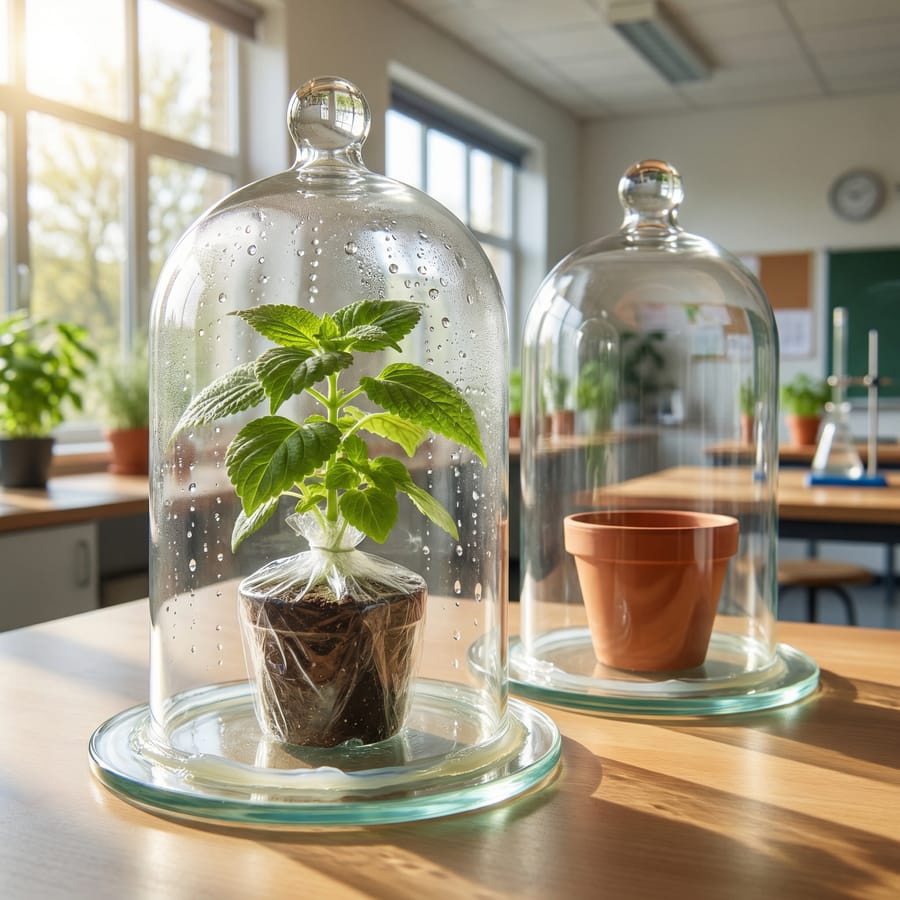
Theory & Background
Have you ever wondered about the amazing properties of water? Plants use sunlight and carbon dioxide present in air to produce food for itself; one of the by-products of this chemical reaction is water vapor. It is possible to trap this water vapor that is released to prove the same.
Required Materials
- 1 Potted plant
- 1 ‘control’ pot without a plant
- Cellophane
- Twine to secure cellophane
- Petroleum jelly
- 2 Bell-jars
- 2 Glass plates
- Anhydrous copper sulphate to test the presence of water
Estimated Time
Approximately 10 minutes to set up the apparatus and 1-2 hours to carry out the observations
Step-By-Step Procedure
Cover the pot and base of stem of the potted plant with cellophane and secure with the twine.
Repeat this with the ‘control’ pot without a plant as well.
Smear petroleum jelly on the glass plates.
Place the pots on each plate.
Invert a bell-jar over each pot.
Leave them outside the laboratory under sunlight.
Experiment Tips
- The base of the stem is covered with cellophane to ensure that moisture from the soil does not affect the results of the experiment.
Observation
After an hour or so, drops of colorless liquid are seen inside the bell-jar containing the plant; no drops of water are found in the control set-up where there was no plant. Testing the liquid with anhydrous copper sulphate (white) causes its color to change to blue.
Result & Conclusion
The change in color of anhydrous copper sulphate from white to blue confirms that the liquid is water.