

Theory & Background
Have you ever wondered about this fascinating scientific process? The temperature of a gas is directly proportional to the speed with which its molecules move. Increasing the temperature of a gas results in an increase of the average speed (and therefore the kinetic energy) of its molecules. This in turn causes the molecules to ‘spread out’ by virtue of a process known as thermal expansion.
Required Materials
- Coin
- Bottle
- Refrigerator
- Water
Estimated Time
Approximately 15 to 20 minutes
Step-By-Step Procedure
Place an empty bottle in a refrigerator to cool
Place the cooled bottle outside
Dip your finger in water and place a few drops around mouth of the bottle and the edge of the coin
Place a coin on the mouth of the bottle
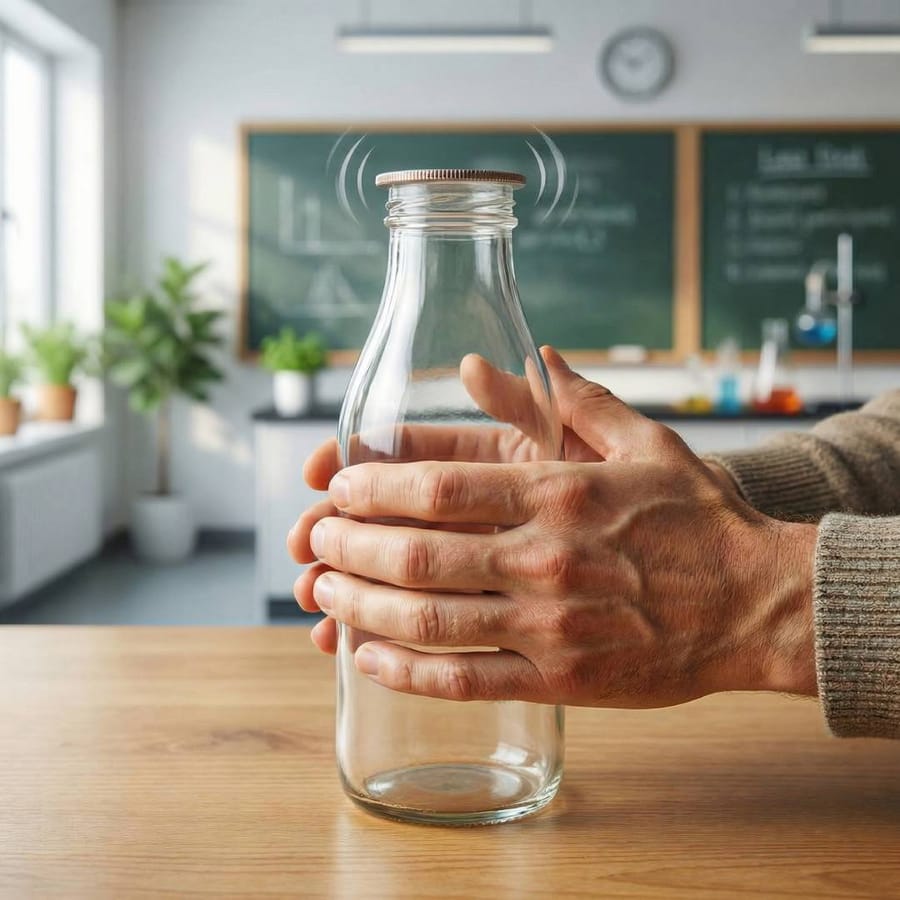
Place both your hands around the bottle; hold firmly
Remove your hands after a while
Experiment Tips
- Use a bottle with a mouth narrow enough to be closed completely with a coin.
- Applying water on the rim of the bottle mouth and the coin’s edge will help seal the bottle.
Observation
In approximately fifteen seconds from covering the bottle with your hands, the coin will start to vibrate up and down. When you do remove your hands after a short while, the coin continues to vibrate.
Result & Conclusion
As soon as the bottle is taken out of the refrigerator the temperature of the gas inside the bottle begins to rise; encasing the bottle with your hands increases the temperature further. When the bottle is heated, the air molecules inside it start moving faster and these molecules collide with the coin with more energy. This results in increased pressure which in turn is caused by the expanding air that escapes though the rim of the coin and makes it vibrate.